
Melbourne’s property market has become a genuine victorian election issue. Building has slowed to its lowest level in over a decade, prices are soft, and buyers finally have some breathing room — and every major party wants credit for fixing it. But here’s the problem: everyone says they’ll “make housing more affordable.” That phrase means nothing on its own.
What actually matters is how each party plans to do it — and there are really only two ways: build more homes, or change who’s competing for the ones that already exist. In this blog, we will guide you through the Labor, Coalition, the Greens and One Nation have each promised. How those levers actually work, and — just as importantly — which ones a state government can even pull.
The Four Numbers That Set the Scene: Victorian Election
- Housing sits near the top of voter concerns for the 28 November 2026 Victorian election.
- Victoria built only about 54,332 homes in the year to September 2025 — the lowest number since 2014 — against a state target that needs roughly 80,000 a year.
- Melbourne’s median dwelling is sitting around $812,621 (houses ~$958,361), auction clearance is near 52%, and buyers currently have the upper hand.
- The real question isn’t who cares most about housing — it’s supply vs demand: does a policy build more homes, or just change who’s competing for the ones we’ve got? That’s the lens for reading everything below.
The Big Picture: It’s Not About Who Cares, It’s About the Lever
Every party will tell you they care about affordability. That’s not useful information. What’s useful is knowing whether their actual policy builds homes or shifts demand around.
Most economists see Victoria’s core problem as a supply shortfall — the state simply isn’t building fast enough. On that view, supply-side policies (planning reform, land release, public building) do the heavy lifting long-term, while demand-side policies (buyer incentives, migration settings, tax changes) tend to move prices around in the short term without adding stock. That’s a mainstream view, not a settled fact — reasonable people disagree on how much weight to give each side.
Two more things worth knowing before you read a single policy: first, planning changes take years to turn into finished homes, so nothing here changes your suburb overnight. Second — and this one really matters — some of the biggest levers (immigration, negative gearing, capital gains tax) are federal, not state. A Victorian party can campaign on them, but can’t actually legislate them from Spring Street.
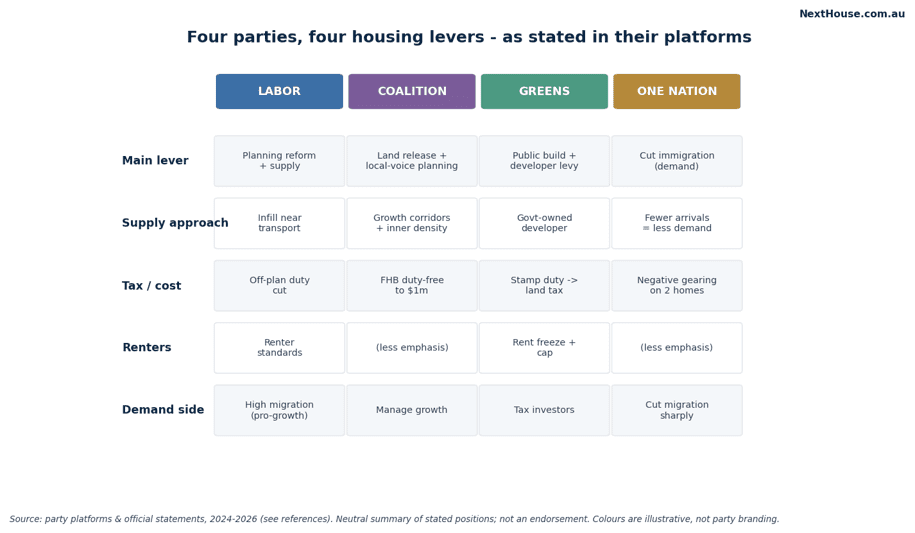
Where each party is putting its main housing focus, based on their own published platforms.
| Party | Headline Housing Promise | Main Lever |
| Labor | Planning overhaul, 800,000 homes/decade target, off-the-plan stamp duty cut (to April 2027) | Supply (planning + infill) |
| Coalition | Stamp-duty-free first homes to $1m, scrap Emergency Services levy, fast-track growth corridors | Supply (land release) + buyer tax relief |
| Greens | 200,000 public homes over 20 years, rent freeze then cap, developer levy | Public building + renter protection |
| One Nation | Cut immigration to reduce housing demand, restrict foreign ownership | Demand (migration) |
The Shared Problem Nobody Disputes
Before getting into the differences, here’s the common ground: Victoria simply isn’t building enough homes. Only 54,332 homes were completed in the year to September 2025 — the weakest result since 2014 — while the population kept growing. The state’s own 10-year target implies it needs to nearly double that pace.
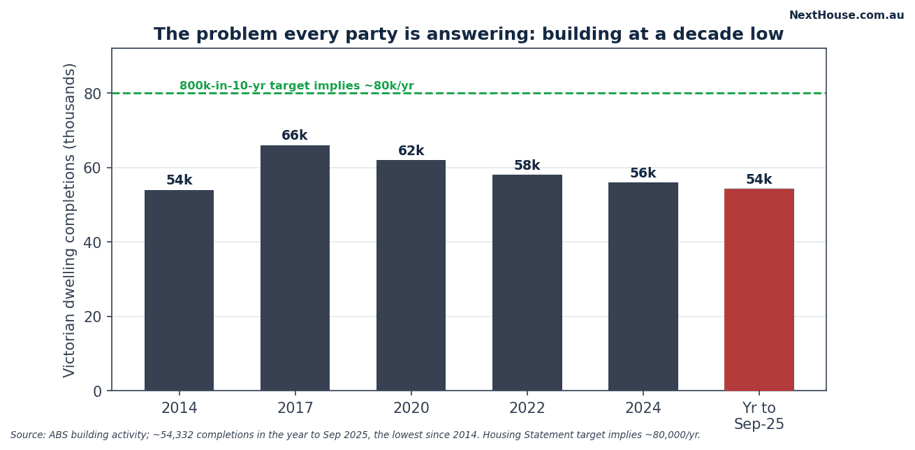
The gap between what Victoria is building and what its own housing plan says it needs.
Every party’s policy — no matter which lever it pulls — is really a proposed answer to this same shortfall. The disagreement isn’t about whether Victoria has a housing problem. It’s about the best way to fix it.
Labor: Planning Reform and Supply
The incumbent Allan government’s approach centres on planning reform. Its headline promise is 800,000 homes over a decade, backed by what it calls the biggest overhaul of Victorian planning laws in decades — housing targets for every council, “automatic” approvals for townhouses that meet set standards, an activity-centres program pushing density near train and tram lines, and a per-dwelling infrastructure levy to fund local roads and schools in growth areas.
On cost, Labor has extended its off-the-plan stamp duty concession through to April 2027, alongside first-home-buyer duty concessions and social housing investment.
The theory: make it faster and cheaper to build medium-density housing near transport, and let extra supply ease prices over time.
What the evidence suggests: planning reform can genuinely lift medium-density supply — but it takes years to show up as finished homes, and independent analysts note that construction costs and interest rates, not just planning rules, are what’s really slowing building right now.
Watch: Your Block Might Not Need a Planning Permit — Here’s the Victoria Law That Changed in 2023
The Coalition: Land Release and Buyer Tax Relief
Led by Jess Wilson, the Coalition also leans supply-side, but focuses on growth corridors rather than inner-city infill — paired with direct tax relief for buyers. Its plan includes exempting first-home buyers from stamp duty up to $1 million, scrapping the Emergency Services levy on family homes, fast-tracking a backlog of growth-area planning approvals, expanding inner-city development zones, and giving local communities more say in planning decisions.
The theory: the planning system has slowed land release and neglected growth areas — clear the backlog and cut buyer taxes, and more homes (and more first-home buyers) follow.
What the evidence suggests: faster approvals could genuinely speed up growth-corridor supply, and a $1m stamp duty exemption would meaningfully cut upfront costs — though demand-side incentives like this can also push prices up in the segment they target.
Watch: The State Just Tripled Land Value in 10 Melbourne Suburbs — 6 Winners + 4 Traps
The Greens: Public Building and Renter Protection
What the evidence suggests: a public build at that scale would add real supply if properly funded — but rent controls are genuinely contested among economists. They can protect existing tenants short-term, but research also warns they can reduce rental supply over time. The land tax shift is widely supported in principle but is a major structural change.
One Nation: The Demand Side and Migration
One Nation’s approach is different in kind — it focuses on demand, specifically immigration. Its position is that record population growth is a major driver of housing pressure, and reducing immigration would ease competition for homes. It also proposes restricting foreign ownership and retaining negative gearing on up to two properties.
The theory: fewer new arrivals means fewer people competing for the same housing stock.
What the evidence suggests: migration genuinely affects housing demand, and population growth has contributed to rental pressure. But here’s the critical catch — immigration is a federal power. A state government can’t actually set migration levels; a state party campaigning on it is expressing a position, not proposing something it can legislate.
The Real Dividing Line: Supply vs Demand
Strip away the party names, and this election comes down to one question for every promise: does it build more homes, or does it change who’s competing for the homes we already have?
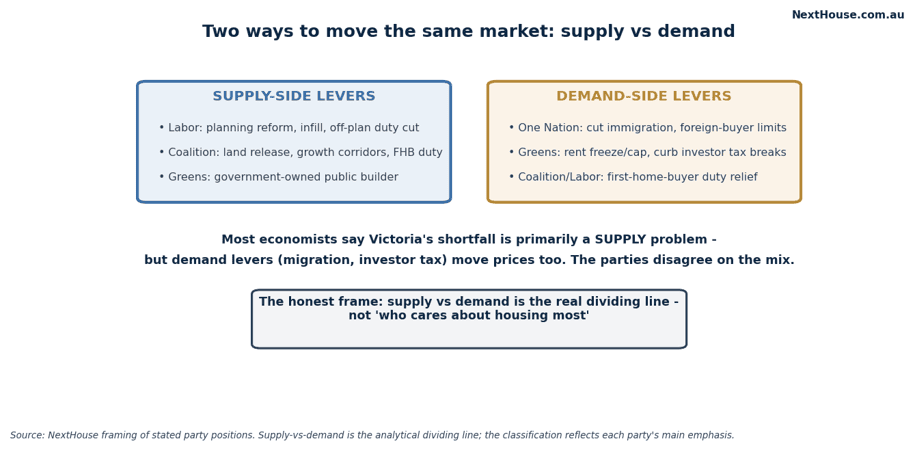
Sorting any housing promise into one of these two buckets tells you what it’s actually trying to do.
| Policy | Supply or Demand? | Adds Homes? |
| Planning reform / activity centres (Labor) | Supply | Yes, over time |
| Growth-corridor fast-track (Coalition) | Supply | Yes, over time |
| Government-owned public builder (Greens) | Supply | Yes, if funded |
| First-home-buyer duty relief (Labor, Coalition) | Demand | No — shifts who competes |
| Rent freeze / cap (Greens) | Demand | No — regulates existing stock |
| Cut immigration (One Nation, federal) | Demand | No — reduces competition |
Neither approach is automatically “right.” Supply-side policies fix the structural shortfall but take years. Demand-side policies can move prices faster, but they don’t put a single new home on the ground.
What Can a State Government Actually Do?
This is the part that trips a lot of people up. Some of the biggest housing levers you’ll hear about during this campaign are federal powers, not state ones.
| Lever | Who Controls It | Can Victoria Actually Change It? |
| Planning rules & zoning | State (+ councils) | Yes — full control |
| Stamp duty & land tax | State | Yes — full control |
| Public/social housing build | State (federal funding) | Yes — can build directly |
| First-home-buyer concessions | State | Yes — full control |
| Negative gearing & CGT discount | Federal | No — can only advocate |
| Immigration levels | Federal | No — can only advocate |
| Foreign ownership rules | Mostly federal (FIRB) | Very limited |
This isn’t a knock on any party — campaigning on federal issues at a state election is completely normal. But practically speaking, the policies most likely to actually change your suburb after November are the state ones: planning, stamp duty, land tax and public building.
The Market Whoever Wins Will Inherit
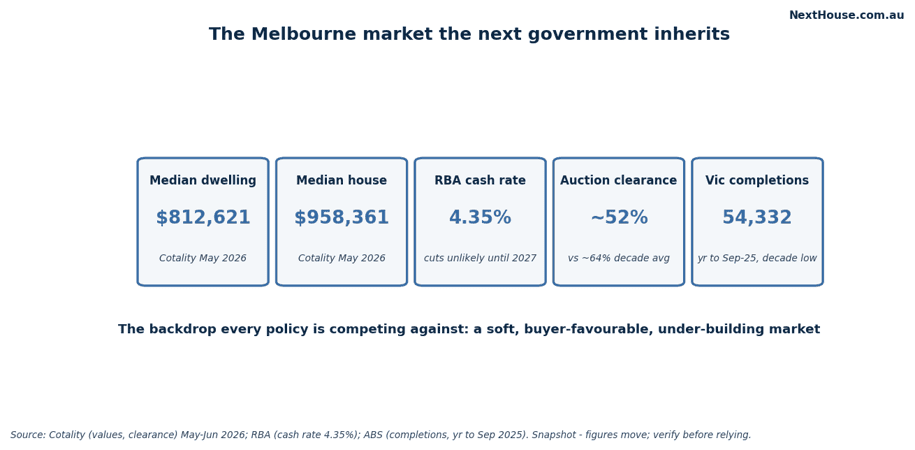
The market backdrop the next Victorian government starts from, mid-2026.
Completions remain at a decade low. That backdrop matters — a policy that would supercharge a hot market behaves very differently in a soft one, and no state planning law can move interest rates.
| Type of Policy | Realistic Time to See Effect |
| Stamp duty / land tax change | Immediate to a few months |
| First-home-buyer incentive | Immediate to a few months |
| Rent freeze / cap | A few months, once legislated |
| Planning reform | 2–5+ years |
| Land release / new suburbs | 3–7+ years |
| Large public housing build | 5–10+ years |
Five Questions to Ask About Any Housing Promise
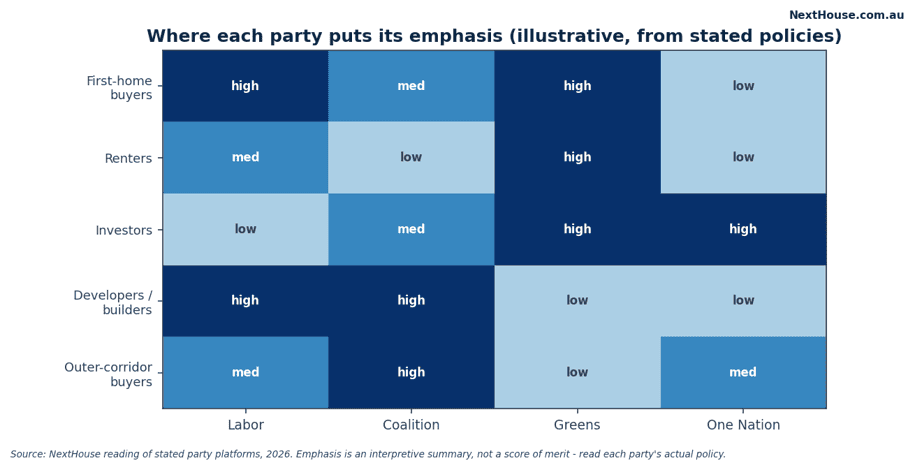
A neutral checklist you can run any party’s housing promise through — this election or the next one.
Whatever policy you’re hearing about between now and election day, run it through these five questions: Is it supply or demand? Is it something a state government can actually do? What’s the real timeline — this term, or a decade away? Who benefits, and who pays for it? And is it actually funded and legislatable, or just an aspiration? These won’t hand you an answer — they’re meant to help you judge the substance instead of the slogan.
The NextHouse View
My honest suggestion, whatever your politics: judge each promise by what it would actually do. Sort it into supply or demand. Check whether it’s even a lever the state can pull. Ask how long it would really take. And notice who gains and who pays. The data can tell you the market is soft and that Victoria is under-building — it can’t tell you how to weigh a renter’s security against an investor’s return. That’s your call to make on 28 November.
This is general information, not voting or financial advice. Verify each party’s current platform directly before voting.
Disclosure: NextHouse is independent and non-partisan. We accept no paid placement from any party, candidate, developer, agent or lender, and this article is not authorised by or affiliated with any political party.
FAQs
- When is the Victorian election and why does housing matter so much?
The election is on 28 November 2026. Housing ranks among voters’ top concerns because the state is building at a decade low while population keeps growing — so every major party has a housing policy this time round. - What’s each party’s main housing policy, in one line?
Labor: planning reform and a supply target. Coalition: land release and buyer tax cuts. Greens: public building and renter protection. One Nation: reducing immigration to ease demand. - Is housing a state or federal issue?
Both, split by lever. Planning, stamp duty, land tax and public housing are state powers. Negative gearing, capital gains tax, and immigration are federal — a state government can only advocate on those, not change them. - Would cutting immigration actually lower Melbourne house prices?
Migration does affect housing demand, and population growth has added to rental pressure — but immigration is a federal power a state government can’t set, and economists differ on how large the price effect would really be. - Do first-home-buyer stamp duty cuts genuinely help affordability?
They do cut upfront costs immediately — that part’s real. But because they boost demand without adding supply, some economists note they can partly flow through into higher prices, offsetting part of the benefit. - Will any of this change my suburb quickly?
Rarely. Tax changes can take effect fast, but planning reform, land release and public building — the policies that actually reshape a suburb — typically take years, sometimes the better part of a decade. - Is this article telling me who to vote for?
No. NextHouse is independent and non-partisan. We’ve described each party’s stated policy with equal scrutiny and drawn no conclusion on who’s right. That decision is entirely yours.
Disclaimer
General information and non-partisan. This article is a neutral summary of each party’s publicly stated housing policies for the upcoming Victorian election. It is not authorised by, affiliated with, or endorsed by any political party or candidate, and does not tell readers how to vote or rank policies by merit. Nothing here is financial, credit, investment, tax or voting advice. Policies are summarised as stated, current to early July 2026, and will change through the campaign — always check each party’s official platform before voting. Some policies discussed (negative gearing, capital gains tax, immigration, most foreign-ownership rules) are federal matters a Victorian government cannot legislate. Market figures are from Cotality/CoreLogic, the ABS and the RBA, current to mid-2026.