
Something interesting is happening quietly beneath the surface of Melbourne’s property market right now. While most Australians are watching the RBA, tracking clearance rates, and debating whether now is the right time to buy — a completely different conversation is happening in Dubai. Wealthy investors who built fortunes during the emirate’s extraordinary boom years are asking a very urgent question: where do we move the money next? And Australia — Melbourne in particular — keeps coming up as the answer. This isn’t a new trend that started with the February 2026 conflict. Dubai Investors capital has been flowing into Australian property since 2018, steadily and deliberately, as part of long-term diversification strategies by some of the world’s most sophisticated wealth managers.
What the Iran conflict did was turn a steady stream into something considerably more urgent.
What Made Dubai So Attractive — and What Changed in 2026?
To understand why Dubai investors money flows toward Australia, you first need to understand the extraordinary machine that created it. Dubai offered them a neutral platform — zero income tax, zero CGT, world-class infrastructure, and the Golden Visa. It was the most successful wealth-attraction strategy of the modern era.
By 2025, Dubai was home to 81,000 millionaires, 237 centimillionaires (worth $100M+), and at least 20 billionaires. The DIFC — Dubai’s special economic zone — reported its top 120 families managed over US$1.2 trillion combined. Then Operation Epic Fury happened. And the one thing Dubai’s entire model depends on — confidence — took a direct hit.
Dubai Millionaire Migration — Net Inflows 2019–2025
| Year | Net Millionaire Inflows to UAE | Wealth Brought (est.) |
| 2019 | ~5,000 | ~US$32B |
| 2020 | ~2,000 | ~US$13B (COVID year) |
| 2021 | ~5,500 | ~US$35B |
| 2022 | ~5,200 | ~US$33B |
| 2023 | ~4,500 | ~US$29B |
| 2024 | ~6,700 | ~US$43B |
| 2025 | 9,800 | US$63B — record |
Source: Henley & Partners Private Wealth Migration Report 2025
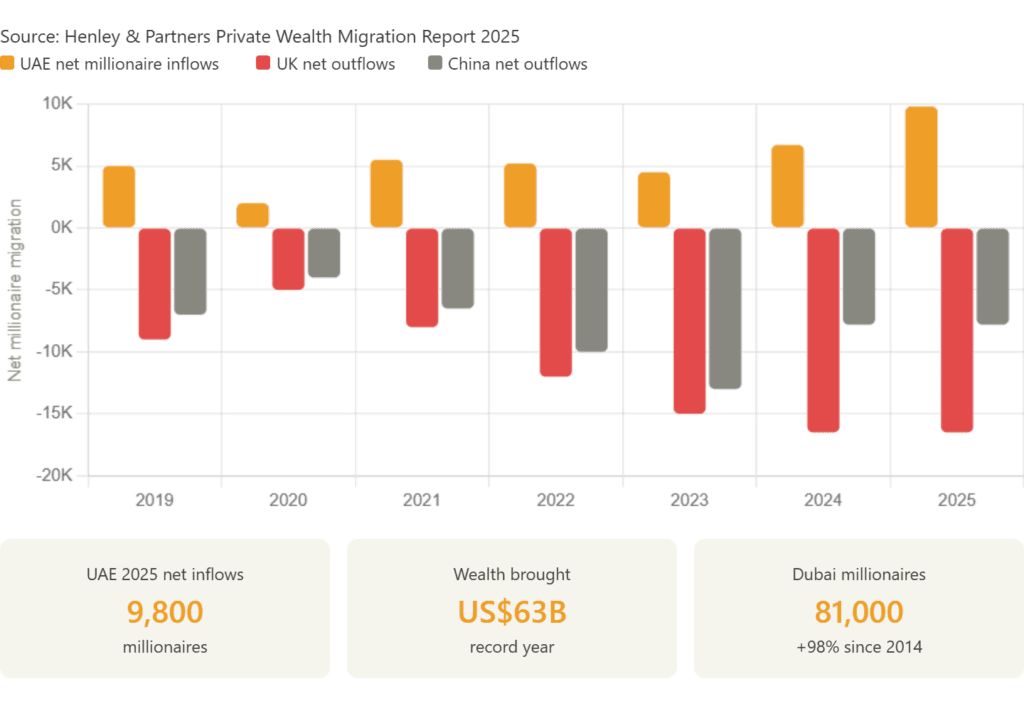
The chart above tells the story of modern wealth migration in one view. The UK and China have been haemorrhaging millionaires for years. The UAE has been the primary destination catching them. Now some of that same capital is moving again — and Australia is one of the places it’s landing.
Why Is Australia the First Place Dubai Investors Look?
When Dubai investors starts looking for somewhere new to park itself, Australia keeps coming up near the top of the list. And it’s not random. It’s structural.
Why Australia Captures Dubai investors Capital Flows
| What Australia Offers | Why Dubai Buyers Care |
| Government-guaranteed property | No disputes or ambiguity |
| Independent courts | Contracts are enforceable |
| No wealth tax, no inheritance tax | No inheritance tax on foreign assets. |
| English language, common law | Familiar system for buyers |
| AAA-rated, free-floating currency | No capital controls. |
| Real migration pathway | PR and citizenship |
Source: NextHouse analysis based on Henley & Partners | FIRB | ATO | CNBC | Reuters
Singapore has been the immediate beneficiary of Dubai capital flight — geographically close, established banking hub, zero hassle. But Singapore charges a 60% Additional Buyer’s Stamp Duty for foreign residential property buyers. That makes property investment there essentially unviable for offshore capital.
Canada had a comparable appeal to Australia — until it banned foreign buyers from established residential property in 2023, extended to 2027. That decision directly redirected flows toward Australia, which remains the most accessible major English-speaking property market for international buyers right now.
Who Exactly Are the Dubai Investors Buying in Melbourne?
“Dubai investors moving to Melbourne” is not one type of person. It’s at least four completely different buyer profiles, each with different budgets, motivations, and target suburbs. Understanding which is which matters — because they don’t all behave the same way in the market.
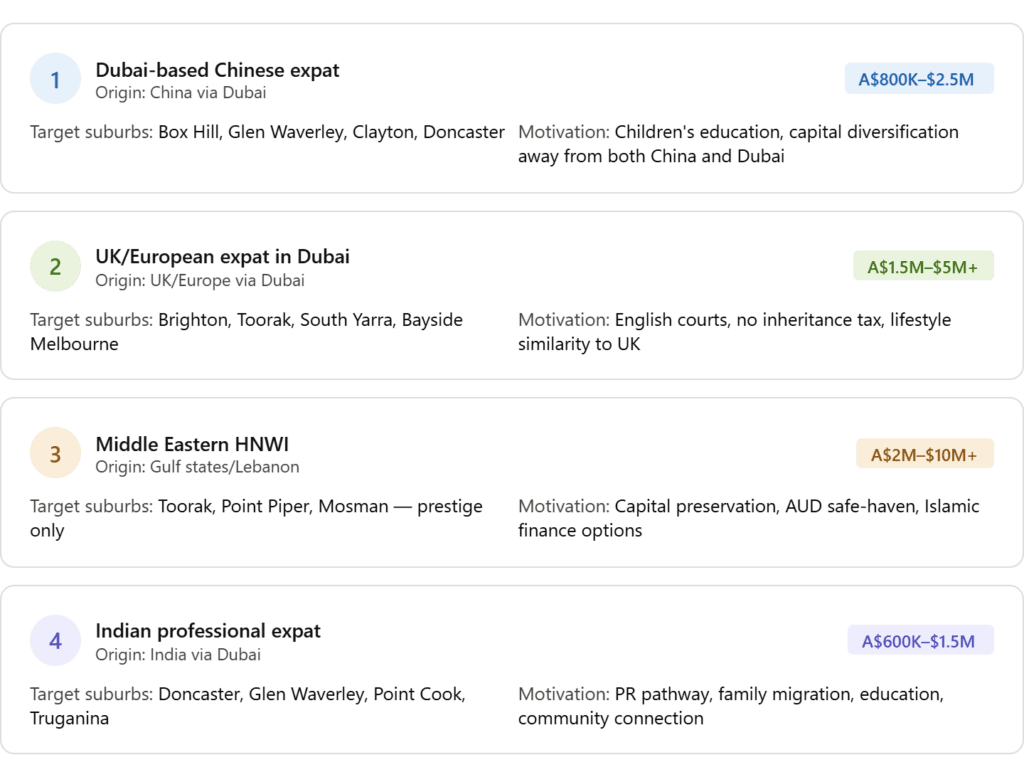
Each of these four buyer types targets different Melbourne suburbs for different reasons. The Chinese expat is chasing school zones and community familiarity. The UK expat is after lifestyle and legal certainty. The Gulf HNWI wants capital preservation at the top end of the market. The Indian professional is building toward a migration pathway.
They are not competing with each other. And they’re largely not competing with you — at least not for the same properties.
What Can Dubai Investors Actually Buy in Australia Right Now?
Here’s the part local Melbourne buyers actually need to know. From April 2025, foreign buyers cannot purchase established homes in Australia. That ban runs until March 2027. Which means international capital is legally channelled away from existing houses — and toward new apartments and off-the-plan developments instead.
FIRB Rules — What Dubai investors Can Purchase Right Now
| FIRB Rule | What It Means for Dubai Buyers |
| Established dwellings — banned (Apr 2025–Mar 2027) | Cannot buy your neighbour’s house. Restricted to new builds only. |
| New dwellings — permitted with FIRB approval | Off-the-plan apartments, new house-and-land packages accessible. |
| FIRB fee (new dwelling under A$1M) | ~A$4,200 — meaningful but not prohibitive for HNW buyers. |
| Victorian Foreign Purchaser Additional Duty | 8% on top of standard stamp duty — on a $1M property, that’s A$80,000 extra. |
| Absentee owner land tax surcharge | 4% per year if not residing in the property. |
| Permanent residents | Treated as Australian citizens — no FIRB restrictions at all. |
Source: ATO.gov.au | foreigninvestment.gov.au | Victorian SRO | FIRB Annual Report 2023–24
The bottom line for local buyers: international buyers cannot compete with you for established houses. They are channelled toward new apartments and off-the-plan developments. The suburbs where this matters most — Box Hill, CBD, Docklands — are the ones with large new development pipelines.
Established houses in school zones? That’s where FIRB restrictions protect local buyers most directly.
Which Melbourne Suburbs Are Dubai Investors Targeting?
Dubai investors don’t scatter randomly across Melbourne. They concentrate in specific corridors that mirror community networks, school zones, and proximity to transport. The pattern is consistent with every previous wave of international capital into Australian property.
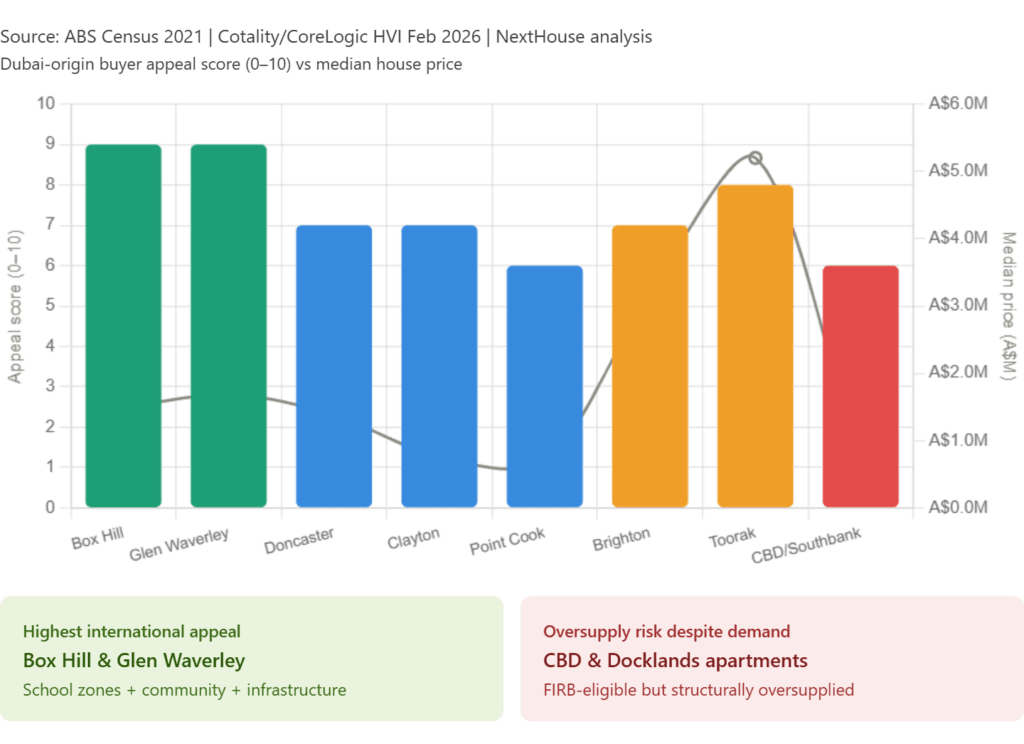
Melbourne Suburbs Dubai investors Are Targeting
| Suburb | Why | Median | Foreign Buyers? |
| Box Hill | Top school zone. Chinese community. SRL East. | $1.49M houses | Yes |
| Glen Waverley | #1 school zone. $380K premium. | $1.69M houses | Limited |
| Doncaster/Templestowe | Melbourne’s Iranian diaspora hub. | $1.38M houses | Developing |
| CBD/Southbank/Docklands | Luxury apartments. High supply. | $580–620K units | Oversupply risk |
| Brighton/Bayside | UK expat lifestyle. Elite schools. | $3.2M houses | Barely any |
| Toorak | Gulf state ultra-prestige. | $5.2M+ houses | Virtually none |
| Point Cook/Truganina | Indian community. Affordable. New estates. | $650–720K houses | Fully open |
Source: ABS Census 2021 | Cotality/CoreLogic HVI Feb 2026 | Davidson Property Advocates | API Magazine | NextHouse analysis
How the February 2026 Conflict Changed the Timeline?
Dubai-based capital was already flowing toward Australian property before Operation Epic Fury. What the conflict did was transform a measured, long-term diversification plan into an urgent conversation happening in real time. The DIFC’s top 120 families manage US$1.2 trillion combined. Even a small percentage of that capital seeking reallocation represents an extraordinary volume of investment looking for somewhere to go.
Australia’s position in this dynamic is specific and structural. It’s not capturing the panic money — that’s going to Singapore in the short term, primarily into liquid financial assets. Australia is capturing the strategic reallocation — the families and family offices that were already watching the Australian market and have now moved their timeline forward.
Where Dubai Capital Is Going Post-Conflict
| Destination | Status | Why |
| Singapore | Short-term winner | Close, safe banking hub — but 60% property tax for foreigners kills investment appeal |
| Australia | Long-term winner | Accessible, rule of law, real migration pathway — 8% surcharge but still the most open major market |
| Canada | Closed | Foreign buyer ban runs until 2027 — capital redirecting to Australia instead |
| UK | Losing appeal | 2024 inheritance tax reform now hits foreign assets — wealth actively leaving |
| UAE | Now the origin | Capital is leaving, not arriving. |
Source: IDNFinancials/Reuters March 2026 | Mothership.sg | CNBC | Henley & Partners | NextHouse analysis
What This Means for Local Melbourne Buyers — Practically?
Here’s the part that actually matters if you’re a Melbourne buyer trying to navigate this market.
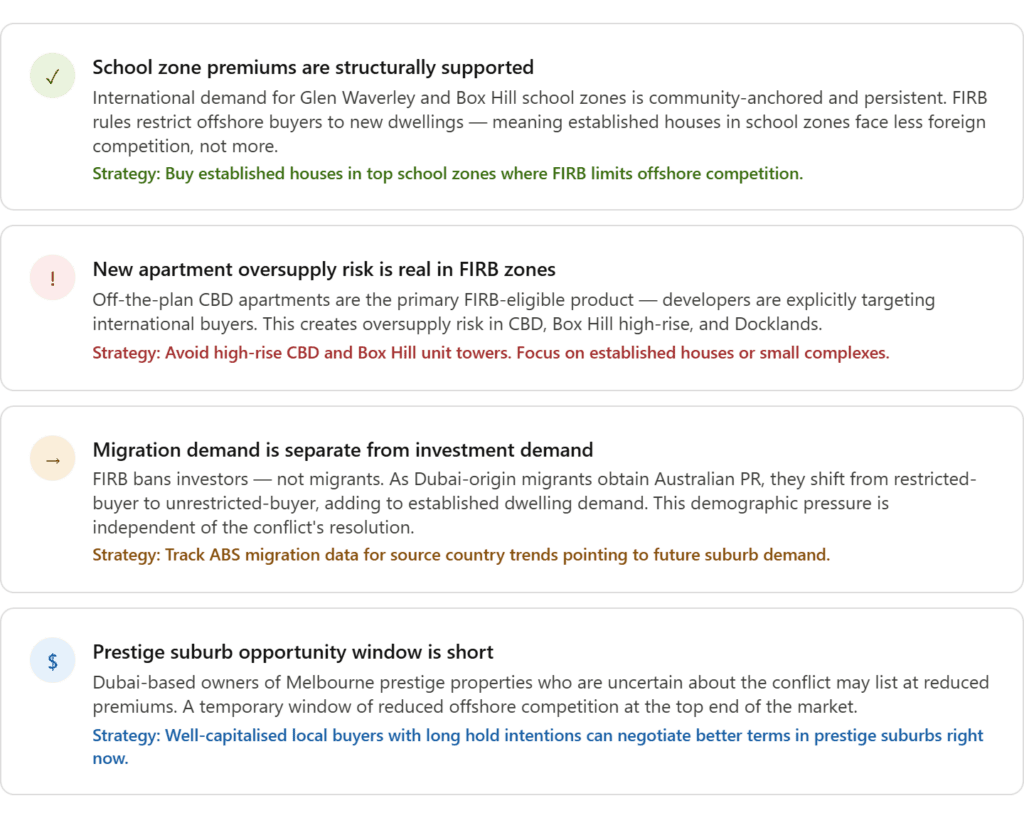
How to Track International Capital Before It Hits Prices?
The signals that international capital is entering a Melbourne suburb appear in the data before they show up in prices. Here are the five most reliable leading indicators — and where to find them.
Your Early Warning System — Five Free or Low-Cost Data Sources
| Signal | Where | Lead Time |
| ABS Overseas Migration data | abs.gov.au — free | 6–18 months |
| FIRB quarterly approvals by country | foreigninvestment.gov.au free | 12–24 months |
| SQM suburb vacancy rates | sqmresearch.com.au — $29.95/month | 0–12 months — strongest signal |
| Council development applications | Whitehorse, Monash, free Melbourne City Council | 12–24 months |
| Juwai IQI Chinese property portal | Media reports available free | 6–18 months |
Source: ABS | foreigninvestment.gov.au | SQM Research | Council planning portals | NextHouse analysis
Final Thoughts
The story of Dubai investors moving toward Melbourne is not one story. It’s three running simultaneously. The first is the long-term diversification trend — wealthy people who built fortunes in Dubai systematically adding Australian property to their portfolios as a stability hedge. The second is the acute flight-to-safety response — conflict-driven capital reallocation happening right now. The third — and most important for Melbourne’s medium-term fundamentals — is the migration story. As Dubai-origin migrants obtain Australian PR, they shift from restricted foreign buyers to unrestricted buyers competing directly in the established market.
For local Melbourne buyers, understanding which suburbs sit at the intersection of these three flows — and what the FIRB rules actually mean for competition in each market segment — is genuinely valuable information heading into the rest of 2026. Want to track which Melbourne suburbs are attracting international buyer demand right now? The NextHouse suburb intelligence dashboard monitors migration data, vacancy rates, development pipelines, and growth trends across Greater Melbourne — updated every month.
FAQs
- Are Dubai nationals allowed to buy property in Australia?
Yes — with conditions. UAE nationals must obtain FIRB approval and are currently restricted to new dwellings only (established dwelling ban runs April 2025 to March 2027). Victoria charges an 8% Foreign Purchaser Additional Duty on top of standard stamp duty. UAE nationals who have obtained Australian permanent residency face no FIRB restrictions at all — they’re treated the same as Australian citizens. - Will Dubai capital flight make Melbourne property more expensive?
For established houses — not directly. FIRB rules channel foreign buyers into new dwellings, not existing homes. The competition for established houses in school zones comes primarily from migrants who’ve already obtained PR — a separate and growing demand driver. For new apartments in the CBD and Box Hill — yes, international demand adds to developer confidence and pricing. The oversupply risk in those areas remains real though. - Which Melbourne suburbs benefit most from Dubai investors flows?
The pattern follows community networks, school zones, and lifestyle — not random guesswork. Box Hill and Glen Waverley lead — top school zones, Chinese community, confirmed infrastructure. Doncaster and Templestowe draw Melbourne’s Iranian diaspora. Brighton and Bayside attract UK and European expats after a familiar lifestyle. Toorak captures Gulf state wealth at the prestige end. CBD and Southbank get the direct investment — but come with real oversupply risk. - How does Australia’s foreign buyer tax compare to Singapore’s?
Singapore charges 60% Additional Buyer’s Stamp Duty for foreign residential property buyers. Victoria charges 8% Foreign Purchaser Additional Duty plus standard stamp duty of approximately 5.5% — around 13.5% total on a $1M investment property. Australia is significantly more accessible than Singapore, which is one direct reason that capital that might previously have targeted Singapore is now flowing toward Melbourne and Sydney more actively. - Can Dubai-based buyers get Australian mortgages?
Yes — but with stricter terms. Australian banks will lend to foreign nationals buying new dwellings with FIRB approval, but typically require 20–30% deposits, cap LVR at 70%, and won’t fully assess foreign income for serviceability. HSBC, ANZ, and NAB have specific non-resident lending products. The AED-to-AUD currency conversion at settlement also introduces timing risk that needs to be managed carefully. - What happens to Melbourne property if the Dubai conflict resolves quickly?
A rapid resolution would reduce panic-driven capital flight but not eliminate the structural diversification trend. Many Dubai investors HNWIs were already planning Australian purchases before the conflict — the conflict advanced their timeline, it didn’t create the underlying motivation. The longer-term driver — migration leading to PR leading to unrestricted buying — operates completely independently of how and when the conflict resolves.
Disclaimer: This report is for educational and informational purposes only. It does not constitute financial, investment, or legal advice. Always seek professional advice before making property decisions.