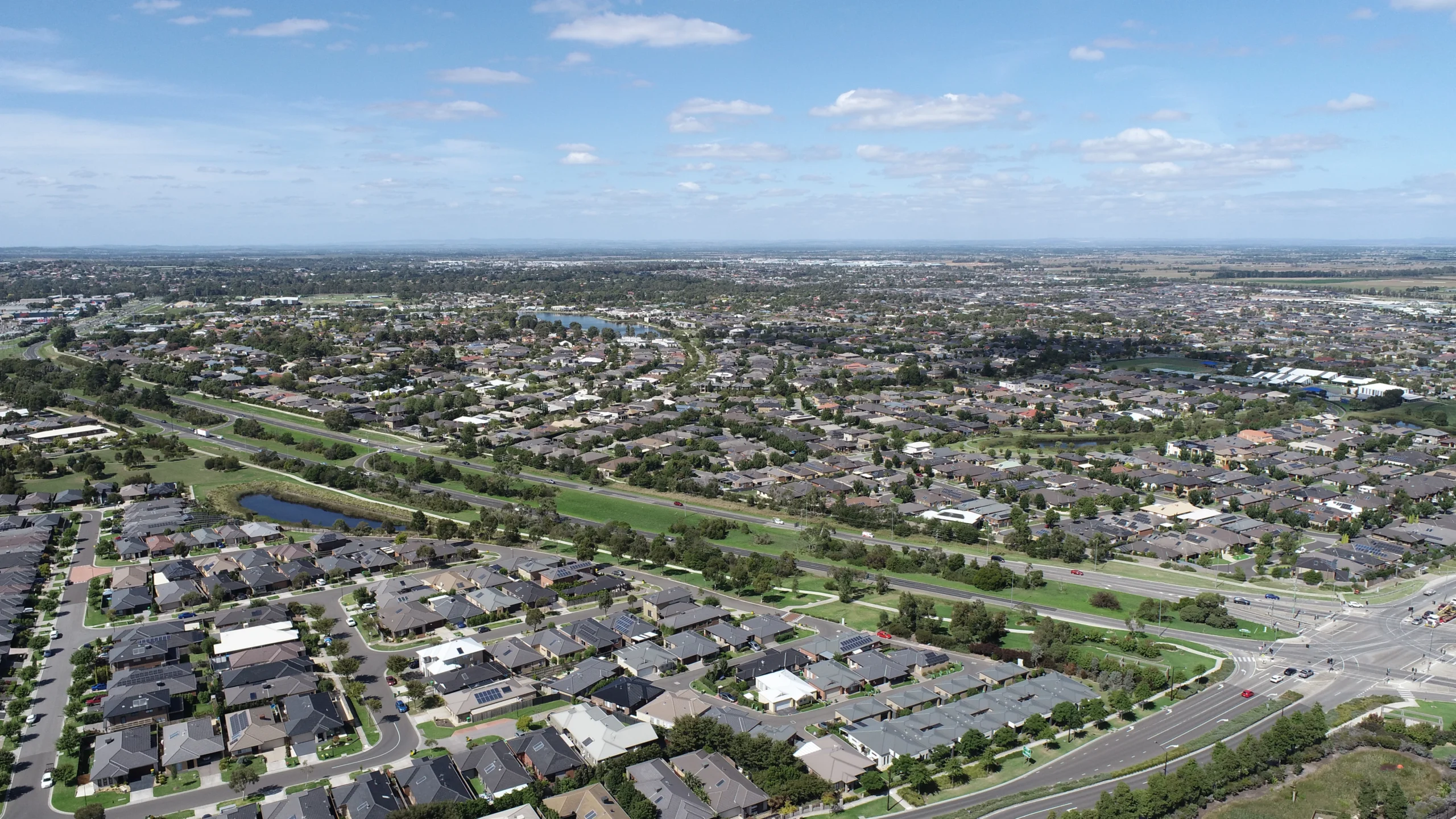
Pakenham gets called Melbourne’s best-value south-east corridor suburb so often it’s started to sound like a sales pitch. And honestly? The track record backs it up — but not for the reasons most people think.
It’s not just the price. It’s not just the yield. It’s the combination of a fundamentally rebuilt rail line, a 22,000-job employment precinct being built from scratch next door, and a population that’s been growing faster than almost any other LGA in Victoria. Put those three things together at a median house price under $750,000 and you’ve got something worth paying close attention to.
But Pakenham also has real risks. New supply coming through Pakenham East. Victorian tax settings that make investor maths genuinely painful. Flood zones in parts of the town centre. And an outer-corridor growth pattern that lags metro Melbourne in the early phase of every recovery cycle.
What Kind of Place Is Pakenham, Really?
Here’s the thing about Pakenham that most property commentary gets wrong: it treats the place like a postcode on a spreadsheet. Pakenham isn’t a fringe suburb that happened to grow. It’s Melbourne’s largest south-east growth corridor town — not a pocket development, not a masterplanned village trying to become something. An actual town, with the population density and commercial gravity to prove it.
The infrastructure story is what separates a market opinion from an investment thesis. Four major arterials converge here — the Monash, the Princes Freeway, the Princes Highway, and the South Gippsland Highway. That’s not a coincidence of road planning. That’s the geometry of a regional hub. Add to that a rail line that was completely rebuilt between 2024 and 2026 — the single biggest infrastructure upgrade this corridor has seen in a generation — and you have a fundamentally different commuter proposition than existed even two years ago.
Most commentary hasn’t caught up to what that number means for long-term demand. It means the southeast growth corridor isn’t just a bedroom. It’s building its own economic engine.
What Are Pakenham’s Property Prices Right Now?
Here’s where it gets slightly complicated — because four different data sources give you four different numbers.
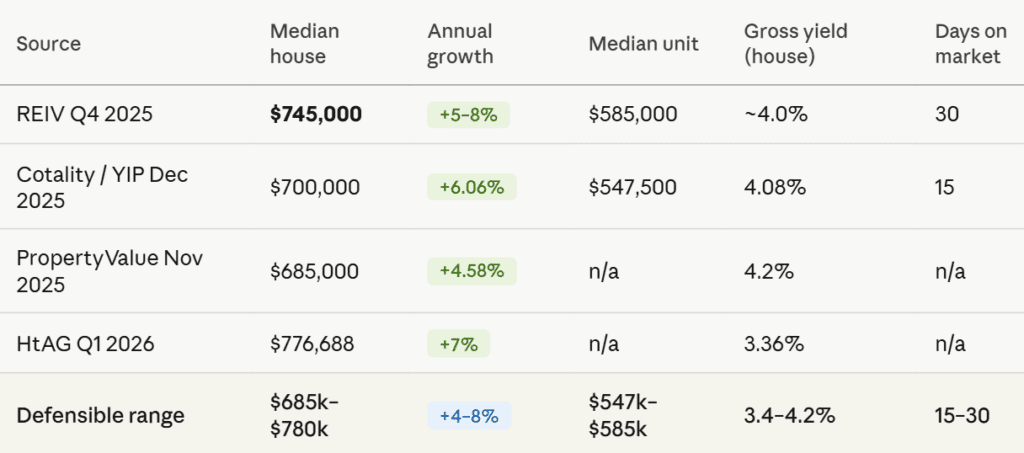
The gap between sources — up to $91,000 — comes down to methodology, not market chaos. REIV uses completed sales with hedonic adjustment. Cotality uses rolling 12-month medians. HtAG uses a “typical price” algorithm that weights recent transactions differently. All defensible. All measuring the same market through different lenses.
The number we benchmark against Melbourne metro is REIV’s $745,000 — because REIV publishes both figures on the same methodology. Against Melbourne metro’s $973,500 median, Pakenham is sitting $228,500 cheaper for broadly similar commute infrastructure. That gap is the core of the value story.
One market signal worth calling out: Cotality recorded 1,039 house sales in Pakenham in the 12 months to December 2025. That is extraordinary transaction depth for an outer corridor suburb — roughly three times the volume of comparable growth corridors. Median days on market of 15. These are not soft market numbers.
How Have Pakenham Prices Performed Over the Last Decade?
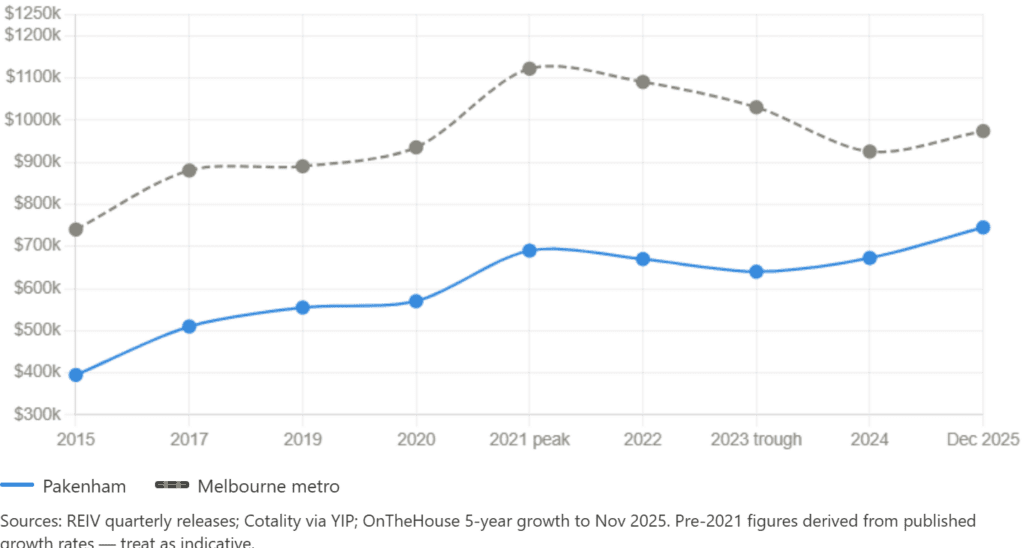
Two things stand out from a decade of data. Pakenham outperformed Melbourne metro over five years to December 2025 — +36.7% versus +19.0%. That’s the classic outer-corridor catch-up: affordable markets outrun established metro when population pressure pushes buyers further out.
But here’s the honest part. The 2022–2023 correction hit Pakenham harder than metro — approximately 7% peak-to-trough versus 5.6% for Melbourne overall. Outer corridors fall harder and recover later. That pattern is real and buyers should internalise it before assuming Pakenham will simply outperform through every market condition.
What’s the Difference Between Pakenham, Pakenham Upper, and Pakenham East?
Not all Pakenham is the same market — and mixing up the sub-areas can cost you real money.
- Pakenham proper (postcode 3810) — 54,118 residents. The main urban area includes the Lakeside, Heritage Springs, and Cardinia Lakes estates plus the town centre. This is what 95% of buyers mean when they say “Pakenham.”
- Pakenham Upper — Semi-rural acreage suburb. Median price around $1.41 million. Very thin sales volumes. Completely different buyer profile.
- Pakenham South — Tiny. 229 residents. Two to three house sales per year. Mostly larger rural holdings with inferred values around $1.46 million.
- Pakenham East / East Pakenham — The growth frontier. Still being absorbed into ABS boundary data — which is why some numbers for this area look patchy.
When someone quotes you a “Pakenham median,” check which Pakenham they mean. The $745,000 REIV figure is for Pakenham proper. Pakenham Upper’s $1.41 million sits in a completely different category.
Who Actually Lives in Pakenham — and Why Does That Matter for Buyers?
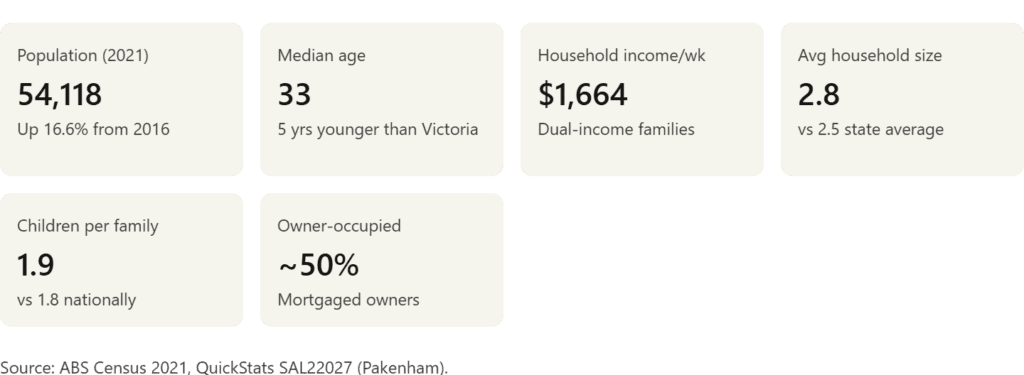
Nearly two children per family. Half the households are mortgaged owner-occupiers. Household income at $1,664 per week sits slightly below the Victorian median of $1,759 — but meaningfully above what the affordable entry price might imply. This is dual-income working families, not a low-income catchment. This is one of Melbourne’s most culturally diverse outer suburbs — and that diversity is still deepening.
On occupations: only 12.8% of Pakenham residents were classified as professionals in 2021 versus 25% statewide. The dominant sectors are construction, retail, health care, transport, and warehousing — exactly aligned with the jobs pipeline being built in Officer South and Cardinia Road Employment Precinct. These residents are already in the industries the precinct will serve.
What Did the Metro Tunnel and Rail Upgrades Actually Change for Pakenham?
This is the part most buyers are underweighting. And it’s the single biggest shift in Pakenham’s investment case in a generation.
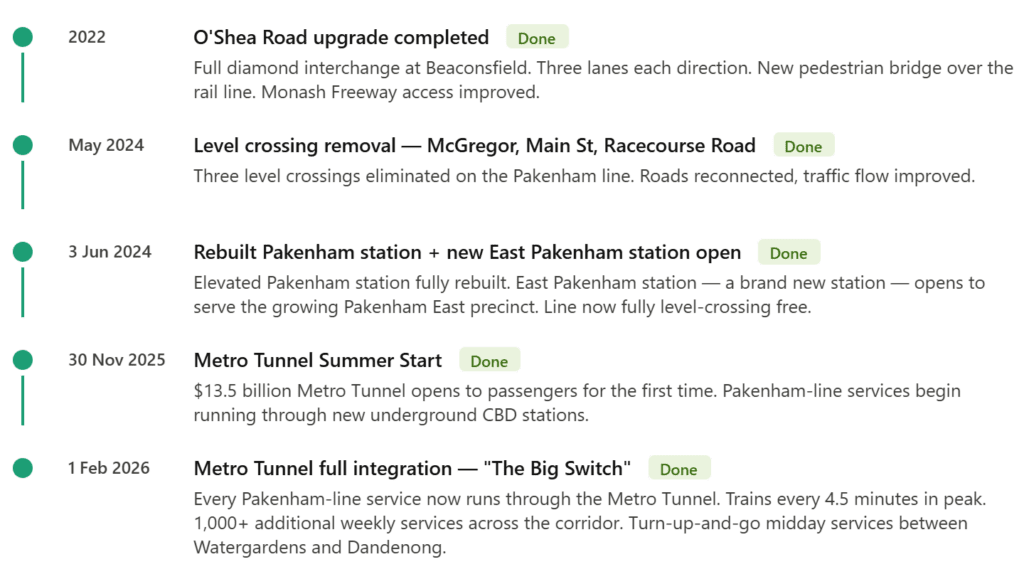
Before February 2026, Pakenham was a 55-minute-plus train ride to Flinders Street via the City Loop with typical 10-minute peak frequency.
Today it’s a 63–75 minute ride directly under the CBD — through Anzac, Town Hall, State Library, Parkville and Arden stations — with trains every 4.5 minutes at peak and turn-up-and-go services through the middle of the day.
That is not a marginal upgrade. That’s a step-change in rail product that closes the functional gap between Pakenham and Glen Waverley. Property markets typically take 18 to 36 months to fully price this kind of shift. The window to buy ahead of full pricing is right now through early 2027.
One important note: Pakenham services no longer stop at South Yarra, Richmond, or City Loop stations. If you need those stops, you change at Caulfield. Worth knowing before you buy.
What Infrastructure Is Coming — and What’s Just Developer Hype?
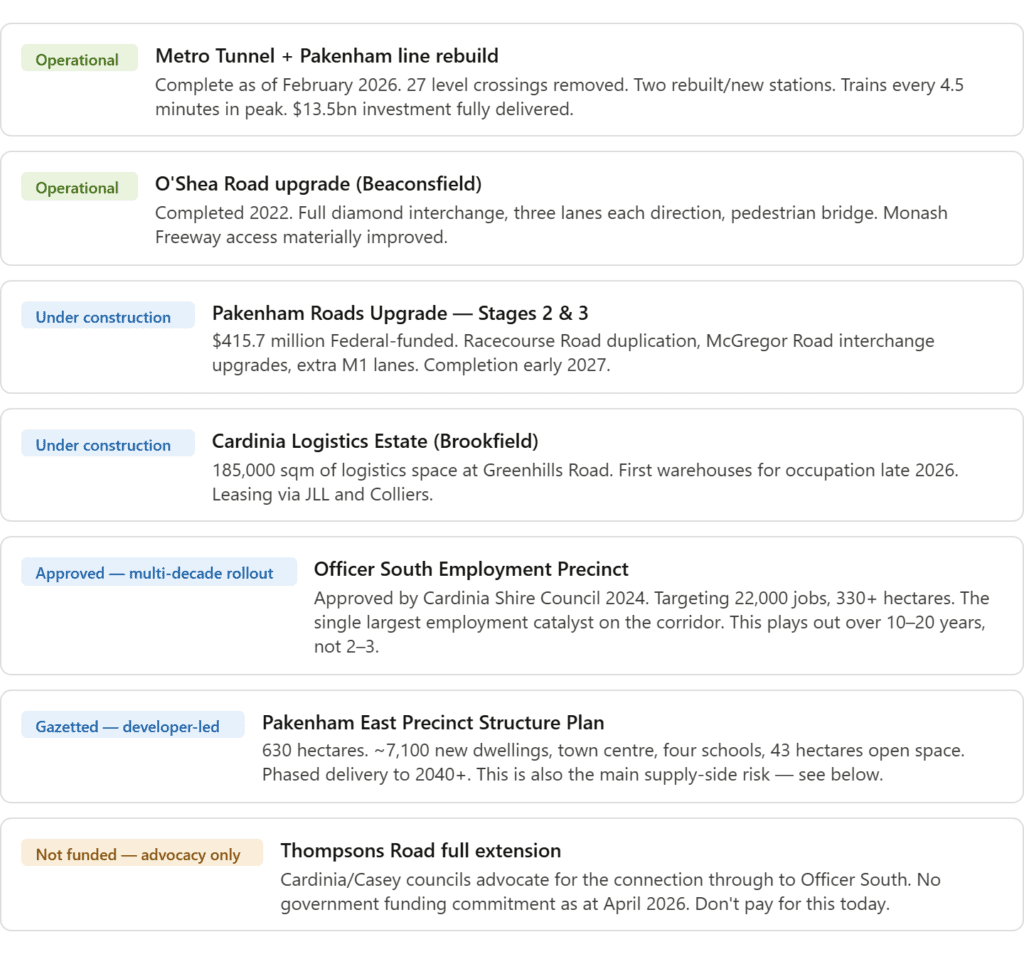
The green items are already in the price. The blue items are what you’re buying forward into. The amber item is speculation — don’t let anyone sell you a property on the basis of it.
The Pakenham Roads Upgrade completing in early 2027 is probably the most immediate near-term price catalyst outside of general Melbourne cycle recovery. Better M1 access means shorter commutes, and shorter commutes mean higher property values.
What Does Investor Math Look Like in 2026?
Victoria remains Australia’s most investor-hostile state for property. Before you run numbers on anything in Melbourne, you need to understand why. The land tax threshold dropped from $300,000 to $50,000. There’s a $975 fixed surcharge on most assessments. The absentee owner surcharge is 4%. Vacant land tax expanded statewide from January 2026.
Here’s what a Pakenham median house actually costs to hold:
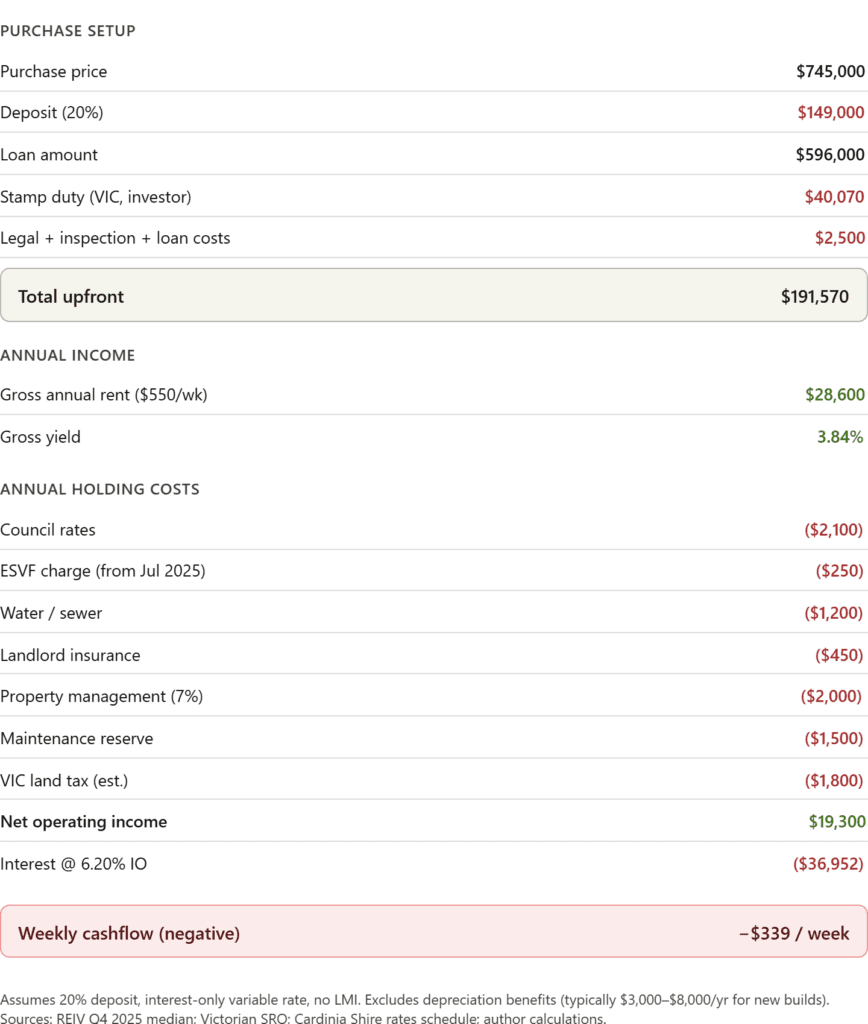
Negative $339 per week before tax benefits. That’s consistent with almost every Melbourne outer-corridor investment I’ve modelled in 2026. Depreciation on a new build typically brings this down to $200–$250 per week in effective cashflow cost.
Pakenham is not a cashflow play. It is a capital-growth play with yield support. If you need positive cashflow from day one, you’re looking at the wrong market.
First home buyers get a completely different deal:
- Full stamp duty exemption on purchases up to $600,000
- Sliding concession up to $750,000 (saving approximately $15,500 on a $745,000 purchase)
- $10,000 First Home Owner Grant on new builds up to $750,000
- Off-the-plan stamp duty concession extended to October 2026 — average saving $24,517, no price cap
The median Pakenham house sits right inside the FHB concession window. Developers have priced to that bracket deliberately. For a first home buyer, Pakenham makes financial sense in a way it doesn’t for a pure investor.
How Does Pakenham Compare to Cranbourne, Officer, and Beaconsfield?
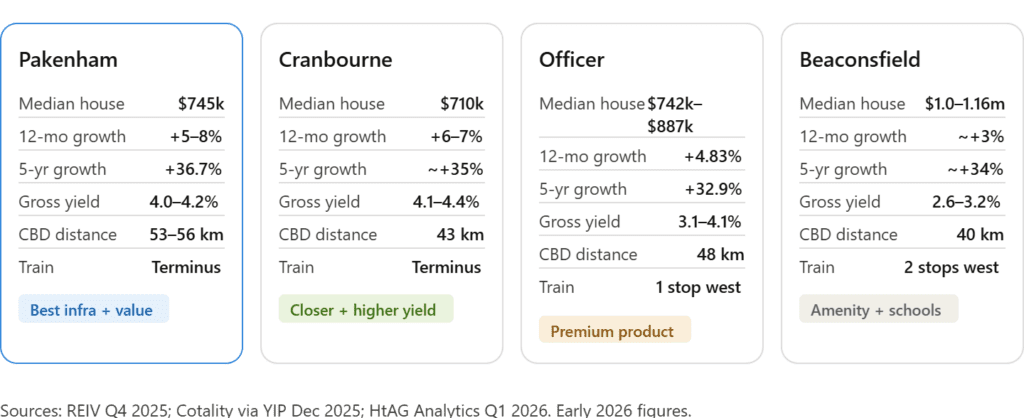
Pakenham vs Cranbourne — these two are the closest parallels. Cranbourne is 12 kilometres west with a shorter CBD commute and slightly higher yield. Pakenham has newer rail infrastructure and the Officer South Employment Precinct directly next door. Investors often hold both for corridor diversification — and that’s not bad advice.
Pakenham vs Officer — Officer is one rail stop west in the same shire, but the median house is materially higher. Officer benefits more directly from the employment precinct; Pakenham benefits more directly from the Metro Tunnel upgrade. For value buyers: Pakenham. For premium buyers: Officer.
Pakenham vs Beaconsfield — Beaconsfield has better established schools (St Francis Xavier College’s senior campus) and higher amenity density, but its median of over $1 million is 35% above Pakenham. Its Building Approvals Ratio at 15% is also the highest in the corridor — significant forward supply risk. Pakenham wins on value and yield.
What Are the Real Risks That Could Hurt Pakenham Buyers?
Here’s what most property content glosses over.
New supply from Pakenham East PSP: That new-build pipeline competes directly with Pakenham resale stock on price and specification. If you’re buying an established home, you need an edge: location near the station, proximity to schools, established street appeal. Generic suburban stock will feel this competition.
Victorian tax settings: Land tax, ESVF, absentee surcharge, vacant land tax — this is a cumulative drag that has driven real capital flight to Queensland and Western Australia. It hasn’t reversed Pakenham’s growth story, but it has compressed investor returns. Factor $5,000–$6,000 in non-discretionary holding costs into every investment calculation.
Mortgage stress: Pakenham’s median monthly mortgage repayment at 2021 rates was already about 24% of median household income — thin margin before the 30% stress threshold. The RBA raised rates to 3.85% in February 2026 and some analysts have modelled further increases through mid-2026. Households in Pakenham proper — lower incomes than the newer estates — carry real stress risk if rates move materially higher.
Bushfire risk on the northern fringe: If you’re considering semi-rural property, pull the VicPlan overlay data first. Insurance premiums and building requirements change materially in BMO zones.
What Are Property Forecasters Saying About Melbourne in 2026?
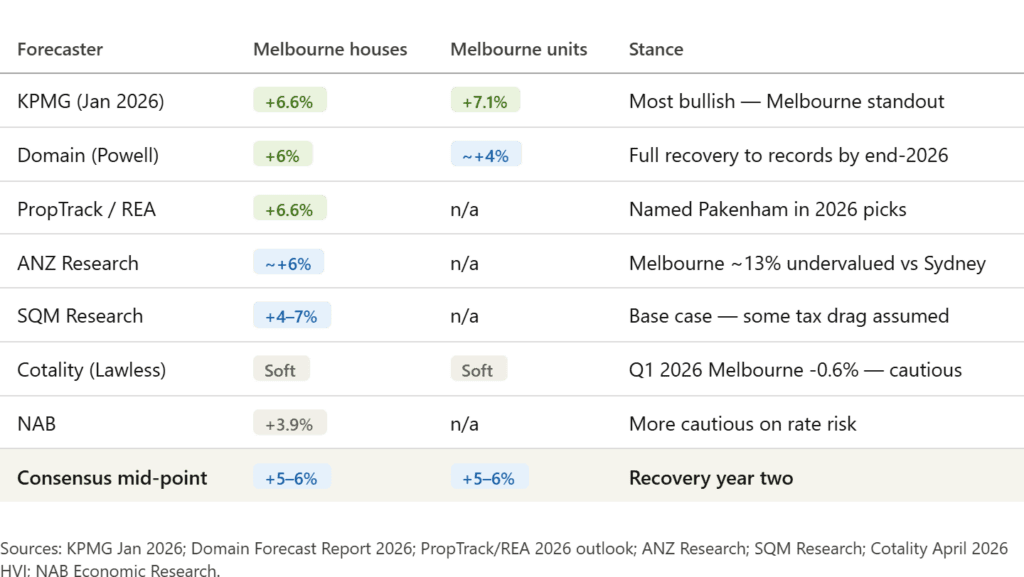
For Pakenham specifically, the outer-corridor lag pattern means the first year of a recovery typically underperforms metro. My working assumption is +4% to +7% for Pakenham houses in 2026, then a stronger 2027 as the Metro Tunnel effect flows through and the Pakenham Roads Upgrade completes.
PropTrack specifically named Pakenham in their 2026 outperformer picks — one of the few outer-corridor suburbs to get that call.
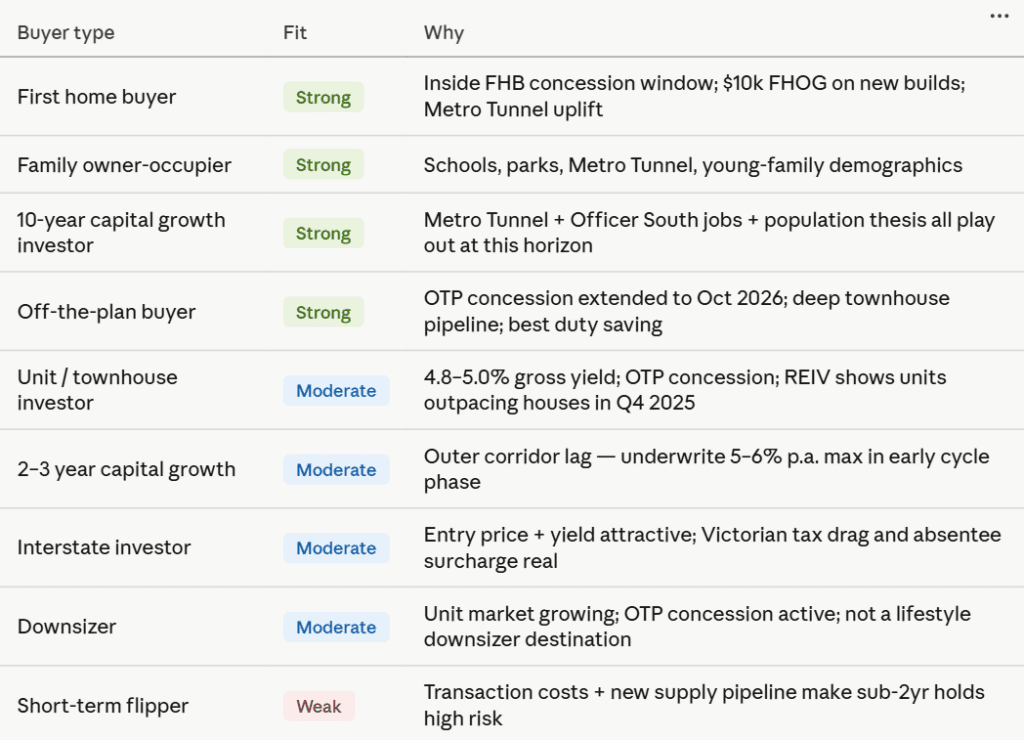
Who Should Actually Be Buying in Pakenham Right Now?
So Is Pakenham Worth Buying in 2026?
Most buyers either overestimate Pakenham’s short-term upside or underestimate its long-term structural case. The truth sits between both camps. The Metro Tunnel is genuinely underpriced in Pakenham values right now. Before 2026, Pakenham was a slow, stop-heavy, City Loop commute. Today it’s 4.5-minute peak frequency directly through the CBD.
The Officer South Employment Precinct is the 10-to-20 year play. 22,000 jobs plus 3,500 at Pakenham South plus the existing Cardinia Road base — when this matures, it reduces Pakenham’s dependence on CBD commute dynamics entirely. For 2026 specifically, my base case is +4% to +7% for houses and +6% to +10% for units. Slightly below KPMG’s Melbourne metro forecast because outer corridors lag in early recovery phases. Stronger 2027 as infrastructure delivery cascades through.
If you’re buying for two years or less, the numbers don’t work. If you’re buying for seven to ten years, the structural case is one of the strongest on Melbourne’s fringe with NextHouse’s guide.
FAQs
- Is Pakenham a good investment in 2026?
Honestly? Yes — but with the right expectations going in. Gross yields sit at 4.0% to 4.2% for houses and 4.8% to 5.0% for units, which is well above what Melbourne’s inner and middle rings are offering right now. Add in the Metro Tunnel that went live in February 2026, a 22,000-job employment precinct being built next door, and a population growing faster than almost any other LGA in Victoria — and you’ve got a genuinely solid long-term case. - What is Pakenham’s median house price right now?
Depends who you ask — and that’s not a dodge, it’s just how property data works. REIV’s Q4 2025 figure puts the median at $745,000. Cotality’s rolling 12-month number to December 2025 comes in at $700,000. PropertyValue.com.au showed $685,000 in November 2025. HtAG’s “typical price” algorithm for Q1 2026 is $776,688. All four are using real data, just measured differently. - What is the Officer South Employment Precinct, and why does it matter for property?
Think of it as Pakenham’s long-term insurance policy against depending on CBD commuters. Stack that with the Pakenham South Employment Precinct adding another 3,500 jobs, plus the existing Cardinia Road base — and you’re looking at a pipeline of over 25,000 direct jobs within the corridor over the next 15 years. When this precinct matures, a meaningful share of them won’t need to anymore. That “live where you work” shift changes demand dynamics permanently — and it’s the kind of catalyst that takes 10 to 20 years to fully play out, which is exactly why most short-term commentary misses it. - Is Pakenham or Cranbourne the better investment?
They’re close enough that this question genuinely doesn’t have a clean winner — which is why a lot of experienced investors just hold both. If you’re a first home buyer, proximity to your workplace probably decides it. If you’re an investor, Pakenham edges ahead on infrastructure timing right now, but Cranbourne’s yield is a genuine argument. Read our full Cranbourne 2026 analysis for a deeper side-by-side. - Are there flood or bushfire risks in Pakenham I should know about?
Yes — and this is the section most property articles skip over, so pay attention. Parts of central Pakenham carry real documented flood risk. The Cardinia Shire Municipal Flood Emergency Plan specifically identifies flash-flood and riverine flood exposure running from the railway station through to Deep Creek. Named risk points include St Patrick’s Catholic Primary School and the underground carpark at Pakenham Central Marketplace. This isn’t hypothetical — these are zones the council has formally identified. Bushfire risk is a different story geographically. It’s concentrated on Pakenham Upper and the northern rural-residential fringe, which sit within Bushfire Management Overlay zones under the Cardinia Planning Scheme. If you’re looking at semi-rural property up there, your insurance premiums and building requirements change materially — check VicPlan before you even start negotiating. For both risks, the rule is simple: pull the Section 32 vendor statement and check the council planning overlays on every individual property before you sign anything. Two streets apart can mean two completely different risk profiles. - What is the Pakenham East PSP, and should it worry me as a buyer?
If you’re buying an established home in Heritage Springs, Lakeside, or Cardinia Lakes — you’re largely insulated from this. New-estate releases in Pakenham East don’t directly compete with your street. But if you’re buying a brand-new house-and-land package as a resale investment, you will be competing against fresher product at similar prices when you eventually sell. That’s real pressure on margins, particularly through 2027 to 2030 when Pakenham East supply peaks. The supply pipeline is a reason to be selective, not a reason to avoid Pakenham altogether. Buy established, buy near the station, buy in streets with genuine character — and the PSP pipeline becomes someone else’s problem.
THE NEXTHOUSE VIEW
Pakenham is one of those rare outer-suburb calls where I don’t have to talk myself into it. The Metro Tunnel changed something real. Before February 2026, getting from Pakenham into the CBD meant the slow grind through the City Loop — the kind of commute that quietly eats your mornings. Now it’s 4.5-minute peak frequency, running straight under the city. That’s not a marginal upgrade. That’s a different suburb. And in my experience, markets take 18 to 36 months to actually absorb a shift that size. Which means right now, while most buyers are still mentally filing Pakenham under “far away” — the window is open.
But the rail story isn’t even what gives me the most conviction. That’s the Officer South Employment Precinct. Twenty-two thousand jobs being built from scratch, right next door. That’s not a price catalyst — it’s a 15-year demand anchor. Slowly, it starts to reduce Pakenham’s dependence on CBD commuters altogether. And when that happens, you’re no longer looking at a suburb that grew because it was cheap. You’re looking at one that grew because it earned it.
My honest concerns: Victorian stamp duty and land tax settings aren’t softening anytime soon. New supply coming through Pakenham East will keep pressure on resale margins for generic stock, roughly through 2027 to 2030. And outer corridors historically lag inner-metro suburbs in the early phase of any recovery cycle — that’s just the pattern.
So the call isn’t blind. But it is clear. Buy near the station. Buy established. Hold for at least seven years. On those terms, Pakenham in 2026 is one of the strongest structural cases I can make anywhere on Melbourne’s south-east fringe — and I’m not squinting at the numbers to say it.
Disclaimer: All data cited is believed accurate at time of publication, April 2026. Property investment involves risk. Past performance does not guarantee future results. Seek independent professional advice.
NextHouse does not provide buyer’s agent services and does not accept paid placement from developers or agents. Read our editorial independence policy at nexthouse.com.au/about.