Melbourne is heading to 6.2 million people. It gets used to sell everything — off-the-plan apartments, outer-suburb land, “buy now before it’s too late” pitches. But here’s what almost nobody tells you: that number is a projection, not a promise, and it doesn’t land evenly across the city. The truth is far more interesting — and far more useful if you’re trying to make a smart property decision. Growth isn’t going to spread across every suburb like butter on toast. It’s going to pour into a handful of specific corridors, while huge parts of Melbourne barely change at all.
The Four Numbers That Matter Most: Melbourne Is Heading to 6.2 Million People
- Greater Melbourne sits around 5.3 million people today and is projected to hit roughly 6.2 million in the early-to-mid 2030s — adding close to a million people.
- The engine behind almost all of it is overseas migration — which is exactly why the number moves whenever federal policy changes.
- The growth isn’t spread out. Six outer council areas — Wyndham, Melton, Casey, Hume, Whittlesea, Cardinia — absorb most of it. Wyndham alone adds around 19,000 people a year.
- And here’s the catch most investors miss: fast population growth doesn’t mean fast price growth. When there’s plenty of land to build on, supply just keeps up with demand — and prices barely move.
So Is 6.2 Million Actually Going to Happen?
Probably, in direction — but hold the exact number loosely. When they reopened, it snapped back to record highs. The date Melbourne is expected to hit 6.2 million — and even whether it overtakes Sydney as Australia’s biggest city — has already been pushed back once by the federal government as migration assumptions changed.
So the direction is solid: Melbourne is very likely growing strongly for years to come. The exact figure and date? Treat that as a scenario, not a fact carved in stone.
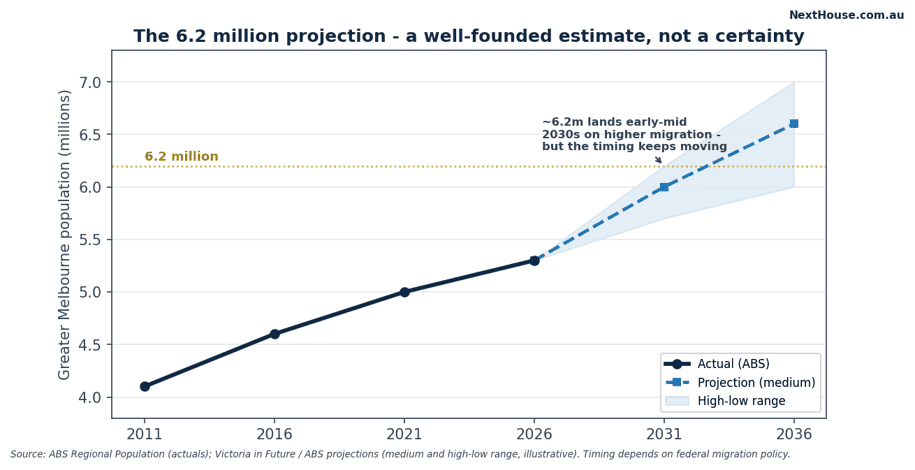
The 6.2 million figure sits inside a wide range — the timing depends heavily on migration policy set in Canberra.
Why Does Melbourne Keep Growing?
It’s mostly one thing: people moving here from overseas. Births minus deaths add a bit. People moving interstate barely moves the needle — some years it’s even slightly negative.
Why do so many people choose Melbourne specifically? A strong job market, big universities pulling in international students, and established migrant communities where family and friends tend to follow each other. Victoria also has more available land and friendlier planning rules than some other states, so it can physically fit more people in. The upshot: Melbourne’s growth is powerful, but it’s tied to a lever pulled in Canberra — which is exactly why “strong growth, uncertain exact path” is the honest way to think about it.
Where Is Everyone Actually Going to Live?
This is the part that matters for property. Growth isn’t spreading evenly — it’s being funnelled into two specific zones: the outer growth corridors on the city’s edge, and select middle-ring suburbs being densified near train and tram lines.
| Zone | Where | How Growth Arrives | What It Means for Property |
| Outer growth corridors | Wyndham, Melton, Casey, Hume, Whittlesea, Cardinia | New house-and-land suburbs | Fast population growth, but abundant supply keeps prices restrained |
| Densifying middle ring | Activity centres near train/tram lines | Townhouses and apartments | Supply is more limited — stronger land-value support |
| Established suburbs (the rest) | Most of the middle and inner ring | Very little change | Scarcity supports values — least transformed |
The Suburbs Doing the Heavy Lifting
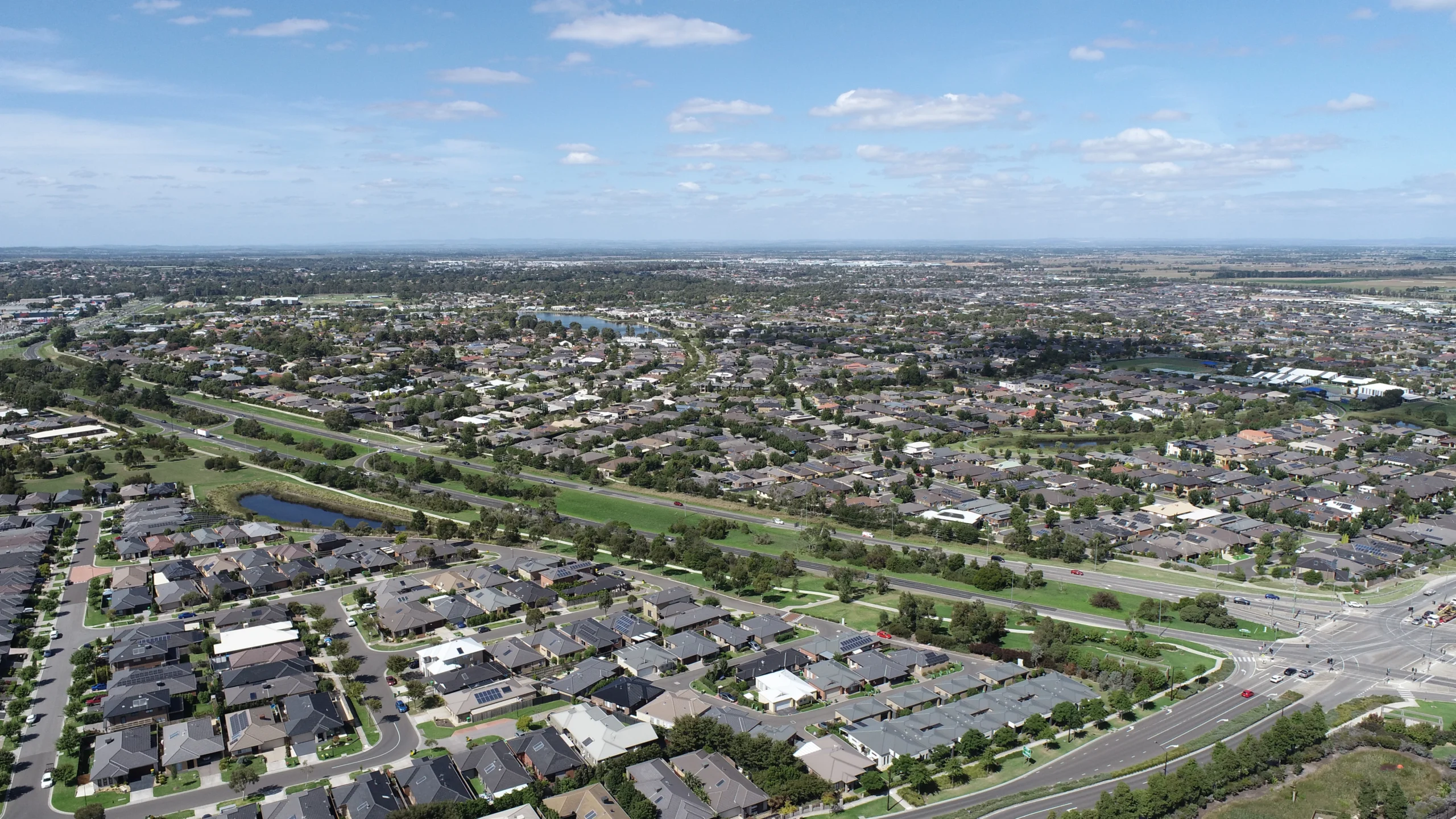
Six outer council areas absorb the overwhelming majority of Melbourne’s new growth, and they regularly rank among the fastest-growing places in the entire country.
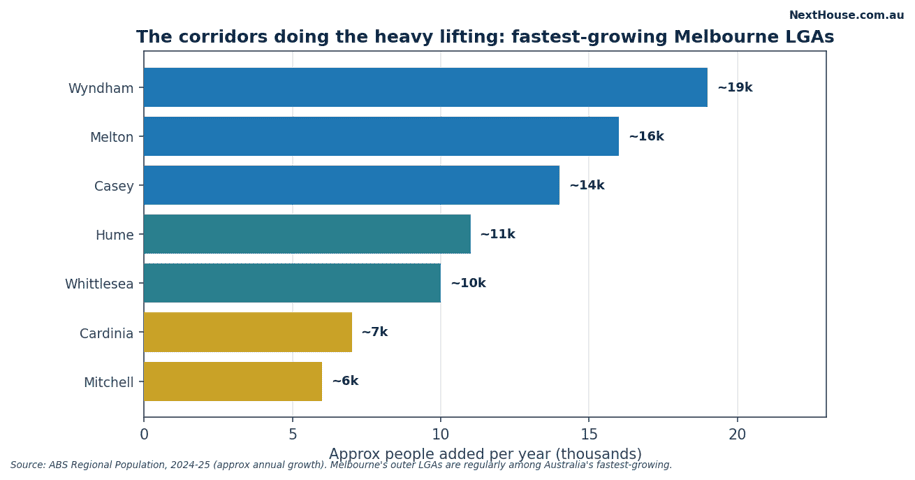
Wyndham alone adds close to 19,000 people every year — more than most regional Australian cities combined.
| Growth Corridor | Key Suburbs | Approx. People Added/Year |
| Wyndham | Tarneit, Truganina, Werribee | ~19,000 |
| Melton | Melton South, Rockbank, Kurunjang | ~16,000 |
| Casey | Clyde, Clyde North, Cranbourne | ~14,000 |
| Hume | Craigieburn, Mickleham, Donnybrook | ~11,000 |
| Whittlesea | Wollert, Mernda, Donnybrook | ~10,000 |
| Cardinia | Officer, Pakenham, Beaconsfield | ~7,000 |
These corridors share the same profile: relatively affordable house-and-land, lots of young families, and fast construction. For first-home buyers — including anyone using the federal deposit schemes — these are genuinely the suburbs where a detached house is still achievable. But the very thing that makes them grow fast in population is what keeps a lid on their prices, which brings us to the biggest trap in this whole story.
The Trap: Fast Population Growth ≠ Fast Price Growth
This is the single most counter-intuitive — and most important — point in this whole article. The instinct is to think: find the suburb growing fastest, buy there, and ride the wave. The data says the opposite happens more often than not.
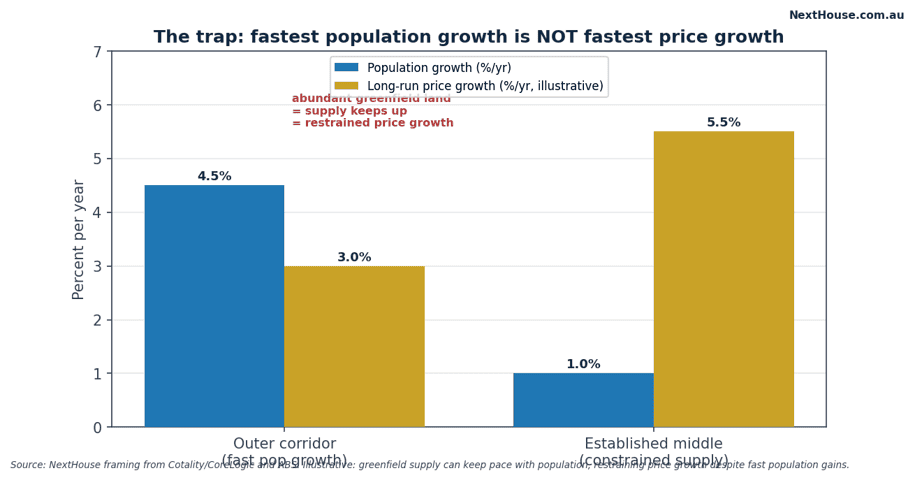
The suburbs adding the most people often see the least price movement — because supply keeps pace with demand.
Here’s why: price growth only happens when demand outpaces supply. The outer corridors have booming demand, but they also have endless tracts of land ready to be built on — so builders just keep building, supply keeps up, and prices stay relatively flat despite all those new residents. An established suburb, on the other hand, can’t easily add new homes. So even a small increase in demand pushes prices up harder.
| Suburb Type | Population Growth | Supply Response | Typical Price Pressure |
| Outer growth corridor | Very fast | Abundant — supply keeps up | Restrained |
| Established, well-located | Slow | Constrained — hard to add homes | Stronger |
| Infill / activity-centre node | Moderate | Rising but contested | Land-value support |
The honest takeaway (this is general information, not advice): if you’re chasing capital growth, look for suburbs where demand is running into a wall of limited supply — which is far more often an established, well-located suburb than the headline-grabbing growth corridor.
Watch: Melbourne’s Cheap Suburbs Are Eating the Blue Chips Alive
The Part Growth-Corridor Buyers Feel Every Day: Infrastructure Lag
There’s a very human side to this that the price charts don’t capture. In growth corridors, people move in years before the roads, schools, trains and hospitals catch up.
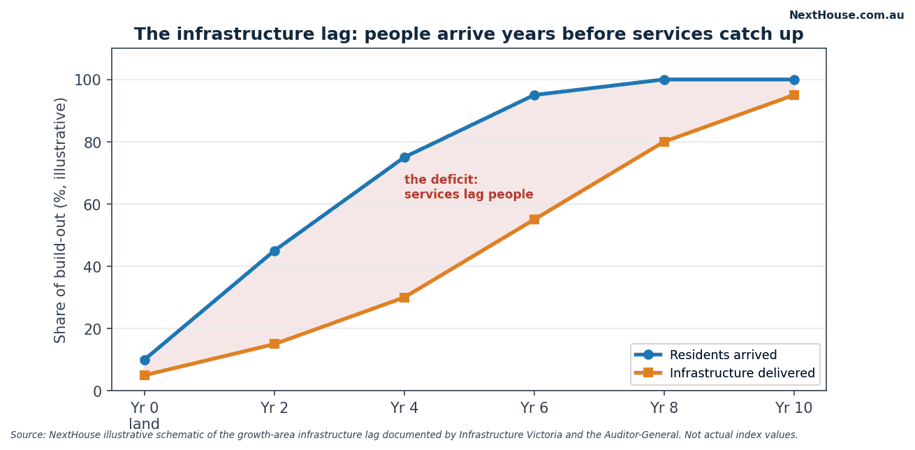
In Melbourne’s growth corridors, people typically arrive years before the infrastructure does.
The pattern repeats itself corridor after corridor: land gets released, families move in fast — but the train extension, new school and hospital often arrive years later, if they get funded at all. For buyers, that’s both a warning and an opportunity. The warning: a cheap corridor house can come with long commutes and stretched services for years. The opportunity: suburbs next in line for funded and committed infrastructure (not just promised) can see a real re-rate once it actually arrives.
Watch: Melbourne Metro Tunnel: 60 Days Later, the Price Data Is In
Five Reasons to Be Optimistic
- A firm floor under demand. A million-plus extra people in a city that’s already short on housing means durable, long-run demand for well-located property.
- Scarcity in the established city. Where supply can’t expand, growth translates most reliably into stronger land values.
- Infill suburbs set to re-rate. Middle-ring suburbs earmarked for densification near transport can see rising land values as development potential increases.
- Corridors keep entry affordable. For first-home buyers, the corridors are where a detached house is still realistically within reach.
- Infrastructure catalysts create winners. Suburbs next in line for funded transport and services can genuinely re-rate once it lands.
Five Reasons to Stay Cautious
- The projection itself is shaky. 6.2 million rests on federal migration settings that can swing dramatically — don’t bank a purchase on a precise figure.
- Population growth isn’t capital growth. Fast-growing corridors often see the most restrained prices, not the strongest.
- The infrastructure lag is real. Years of long commutes and stretched services are common in new growth suburbs.
- Oversupply risk. Where builders can add homes freely, supply can temporarily outrun demand and soften prices or rents.
- Growth won’t stop a downturn. Population growth works underneath the market over decades — it didn’t stop prices falling during the 2022-23 rate hikes, and it won’t next time either.
Three Playbooks, Depending on Who You Are
If you’re a first-home buyer chasing affordability: the corridors deliver a real detached house within reach — just go in with realistic price-growth expectations, and check which infrastructure is actually funded (not just announced) before you commit.
If you’re an investor chasing capital growth: look past the fastest-growing corridor and toward constrained, well-located established suburbs — especially ones marked for infill near transport, where demand is bumping up against limited supply.
If you already own in an established suburb: the growth story is quietly working in your favour. Scarcity plus a growing city supports your land value over time. Just keep an eye on whether your suburb gets targeted for major densification — that changes its future either way.
The NextHouse View
The growth has a map: six outer corridors and a handful of densifying suburbs do almost all the work, while much of established Melbourne barely shifts. And the trap catches even smart, careful buyers: the fastest-growing suburb is usually not the best for capital growth, because the very land abundance that lets a corridor add 19,000 people a year is exactly what stops its prices from running. Data shows again and again that capital growth comes from demand meeting constrained supply — and that’s more often the quiet, well-located established suburb than the headline-grabbing growth corridor.
My honest take: use the growth story as a reason for long-term confidence in well-located Melbourne property. Buy the corridors for affordable access with realistic expectations and a hard look at what infrastructure is genuinely funded. And if you’re chasing growth, look where supply can’t keep up — not where the population chart is steepest.
This is general information, not advice. Verify current projections and planning status, and speak with a licensed professional before making any property decision.
Disclosure: NextHouse does not accept paid placement from developers, agents, land developers, lenders or any third party.
FAQs
- When will Melbourne actually reach 6.2 million people?
Official projections put it at roughly the early-to-mid 2030s, up from about 5.3 million today — but it’s a projection with a wide range, not a fixed date, and depends heavily on federal migration settings. - Does population growth actually push up house prices?
Over the long run and in aggregate, yes. But it’s uneven — fast-growing corridors often see restrained price growth because supply keeps up, while constrained established suburbs can see stronger growth from far less population change. - Why isn’t the fastest-growing suburb the best investment?
Because price growth needs demand to outrun supply. Corridors grow fast in population precisely because they have abundant land — and that same abundance keeps prices in check. - What’s the infrastructure lag everyone talks about?
It’s the well-documented gap between people moving into a growth corridor and the roads, schools, trains and hospitals actually catching up — often a wait of several years. - Will Melbourne overtake Sydney as Australia’s biggest city?
It’s been projected at various points, but the timing keeps shifting as migration assumptions change — best treated as a possible scenario, not a scheduled event.
Disclaimer
General information only. This article does not constitute financial, credit, investment or tax advice, or a recommendation to buy, sell or hold property in any suburb or corridor. The 6.2 million figure and its timing are official projections resting on assumptions — chiefly federal migration policy — that have shifted significantly before and could again. Figures and suburb examples are approximate and illustrative, drawn from ABS, Victoria in Future and Cotality/CoreLogic data current to mid-2026. A central point of this article is that fast population growth does not automatically mean fast price growth — nothing here should be read as suggesting a fast-growing suburb is a good investment. NextHouse does not accept paid placement from any third party.