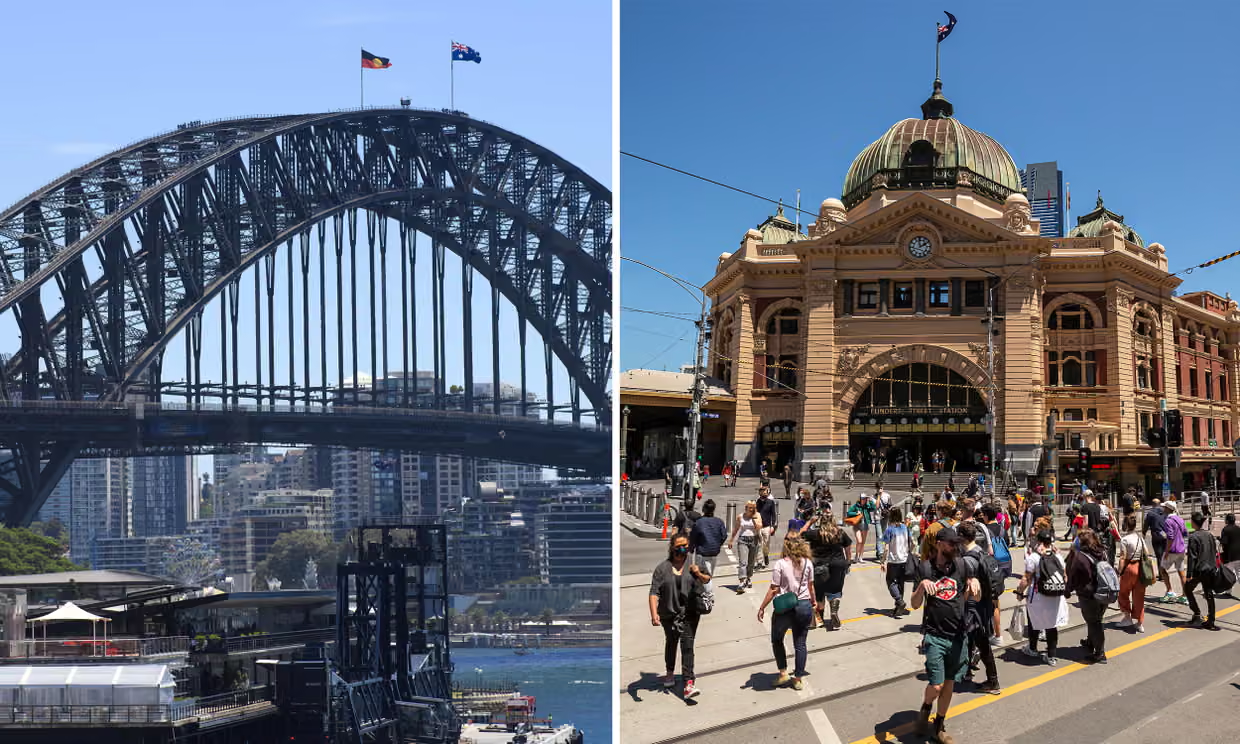

Sydney and Melbourne aren’t coming back to “affordable” anytime soon. That’s just the reality. Prices are stretched, yields are ordinary, and unless you’ve already got a huge deposit sitting in a savings account doing nothing, the big cities are increasingly hard to justify. The maths just doesn’t stack up the way it used to for regional property.
But here’s the thing — that’s not actually bad news for most investors. It just means the opportunity has shifted. Regional towns has been quietly doing the work. Tight rental markets. Genuine population growth. Entry prices that still make sense. And in a lot of cases, yields that capital city investors would look at with genuine envy.
This isn’t about settling for second best. For a growing number of people running the numbers in 2026, regional property isn’t the backup plan — it’s the plan. Here are 7 best regional towns worth your attention, and the honest reasons why each one makes the list.
Why Regional Towns Make Sense Right Now?
What happens when more people want to live somewhere than there are homes available for them? The entry price gap is the other side of it. In most of these towns, you can buy a solid investment regional property for a fraction of what you’d pay for something comparable in Brisbane — let alone Sydney. That lower entry point means better yields from the start, and it leaves more room for the market to move in your favour over time.
Neither of these things is complicated. They’re just easy to miss when all the noise is coming from the capital city end of the market.
1. Albury-Wodonga — The Border Town That Earns Its Reputation
Albury-Wodonga surprises a lot of investors who actually take the time to look at it properly.
Sitting on the NSW-Victoria border sounds like a geographic curiosity, but it actually gives the best regional towns a genuinely unusual economic position. Healthcare, education, logistics, government — the job base is diverse in a way that smaller regional centres usually aren’t. And yet the prices still reflect a regional market, not a city one.
Vacancy is tight. Rents are in demand. The population has been growing steadily without a lot of fanfare. What you get is a town that delivers on both fronts — income now, and a reasonable case for growth later — without forcing you to pick one over the other. That balance is harder to find than it sounds.
2. Geelong — Not Cheap Anymore, But Not Done Either
The people who bought into Geelong five years ago made good money. Nobody’s pretending otherwise. Prices have moved, neighbourhoods have changed, and nobody’s calling it a hidden gem anymore — because it isn’t one. The transport connections are better. Jobs have followed people, and people have followed jobs. The lifestyle appeal is real — not manufactured for a brochure, but the kind that actually makes someone choose to put their life there. That shift tends to hold.
Grovedale gives you a way that’s still relatively sensible. Is it as cheap as it once was? No. But the fundamentals that drive a rental market — people wanting to live somewhere, not enough homes to go around — are still very much intact. The window’s smaller than it was. It hasn’t closed.
3. Townsville — Consistent, Credible, Hard to Argue With
There’s a reason Townsville appears on almost every serious regional investor list. It’s not hype — it’s the economic foundation underneath the town.
Defence, a working port, healthcare, education. Rental demand is high. Supply has stayed tight. Yields are genuinely solid. And there’s still a credible capital growth story sitting on top of all that. For investors who want cash flow without giving up on long-term upside, Townsville is a difficult one to talk yourself out of.
4. Bundaberg — Quietly Getting On With It
While flashier Queensland markets have been picked over thoroughly, Bundaberg has just kept moving in the background. Infrastructure investment is continuing. And the entry prices are still accessible in a way that a lot of Queensland markets aren’t anymore. Consistent rental demand plus a growing population is often the combination that shows up just before prices start moving more noticeably. Bundaberg still has the feel of a market that hasn’t fully priced that in yet.
5. Murray Bridge — Adelaide’s Overflow, and Benefiting From It
Adelaide has had a strong run. Which means buyers who can’t stretch to city prices are increasingly looking further out — and Murray Bridge has been one of the clearest beneficiaries of that shift. And genuinely appealing to families and retirees looking for space, lifestyle, and a cost of living that doesn’t require heroic financial management.
Population growth is picking up pace. Rentals are in demand. Development activity is increasing. Among South Australia’s regional options in 2026, Murray Bridge is the one moving with the most momentum.
6. Wagga Wagga and Griffith — Steady, Reliable, and Underappreciated for It
Wagga Wagga isn’t going to show up in a viral regional property article. That’s almost exactly the point.
What it will do is keep performing — quietly, consistently, year after year — because the foundations are genuinely solid. A university, an RAAF base, hospital infrastructure, and freight networks that serve a wide region. There’s always going to be someone who needs a rental in Wagga, and that reliable demand is exactly what makes it a smart portfolio addition rather than a speculative punt.
Griffith sits alongside it for similar reasons. Deep agricultural roots, a tight rental market, and a community that tends to stay put rather than move on. Together, these two towns are the kind of performers that don’t make for exciting conversation but do make for good investment decisions. Sometimes that’s the better trade.
7. Launceston and North-West Tasmania — For Investors Who Can Wait
Entry prices remain low relative to comparable mainland markets. Rental returns are attractive. And people from the mainland are still relocating there — not because it’s trendy, but because the lifestyle and cost of living actually make sense in a way that’s becoming harder to find elsewhere.
This isn’t a market you buy into looking for a quick result. But if a longer holding period suits your situation, Tasmania offers consistent, measured growth without the inflated price tag that comes with chasing the next hot market. Portfolios need that kind of steady presence more than most investors realise.
What Actually Separates the Good Ones From the Rest?
Not every regional towns is worth your money. A few things consistently separate the markets that perform from the ones that disappoint: More than one industry driving the local economy. People actually choose to move there. Population growth is the most straightforward signal in property. More residents means more tenants, more competition for rentals, and steadily rising demand over time.
Low vacancy rates. Persistently empty rentals are a red flag, not a buying opportunity. Low vacancy means genuine demand — and genuine demand is what makes an investment work in practice, not just on paper.
An entry price that still leaves room. The lower you get in, the better the yield from day one — and the more upside is available as the market matures. Chasing markets that have already run hard is a different and riskier proposition.
At a Glance — The Property Investment in 2026 Comparison
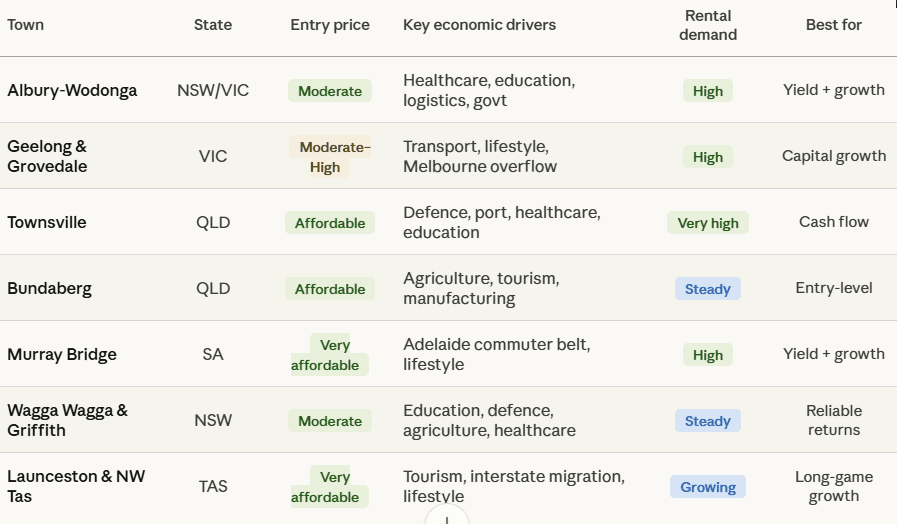
Where Does This Leave You for Regional property?
Regional property in 2026 isn’t a compromise. For a lot of investors running honest numbers right now, it’s genuinely the stronger option. Better yields, more accessible entry points, and real growth potential grounded in real economic fundamentals — not just the expectation that prices always go up because they always have.
The capital cities still have their role. But the idea that you have to be in Sydney or Melbourne to be making a serious property investment in 2026 is looking increasingly dated. The regions have caught up — in some ways, they’ve moved ahead. The key is being clear on what you’re actually trying to achieve. Cash flow looks different to capital growth. A ten-year horizon looks different to a five-year one. The best regional towns that’s right for your situation might not be the one making headlines — and that’s often a good sign.
If you’re weighing up a move into regional property, it’s worth having a proper conversation about what the numbers actually look like for your circumstances. To know more about the best regional towns in Australia for property investment in 2026, visit NextHouse and ezplore further.
Disclaimer: This is general information only — not financial, investment, or legal advice. Please talk to a qualified professional before making any property decisions.