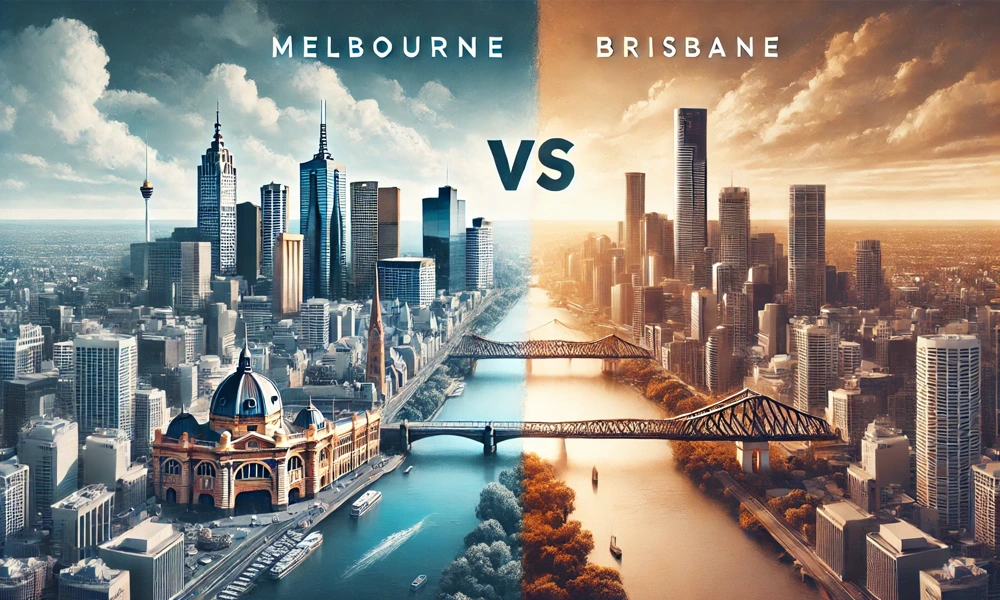

If you’ve been anywhere near a property ROI in 2026 conversation lately, you already know this one. It comes up at dinner parties, in catch-ups with buyers’ agents, at every investment seminar. Sydney vs Brisbane?
Someone always brings it up. Sydney or Brisbane? For a long time, Sydney was the obvious answer. Nobody really questioned it. Biggest city in the country, financial capital, the name that every overseas investor knows without blinking. It was just the default.
But Brisbane in 2026 is making people stop and think twice. The rental yields are stronger. The price growth has been faster. “More money” means different things to different investors. More cashflow each month? Bigger gains when you sell? A safer long-term hold?
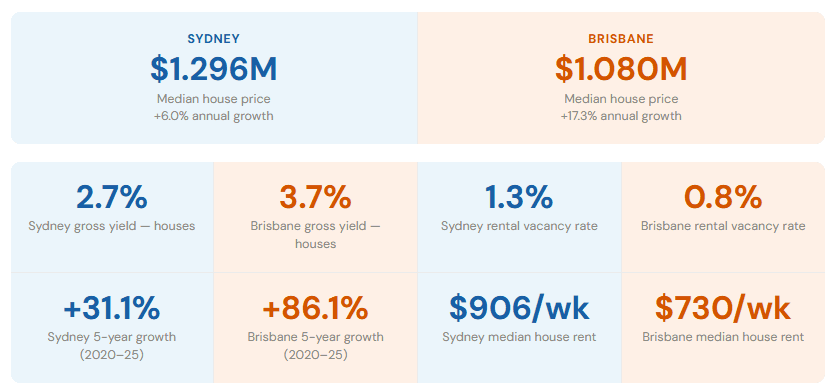
Sydney vs Brisbane: Where Both Cities Stand Right Now?
Once you look at what each city earns in rent relative to what you paid for it, that gap feels a lot smaller. Brisbane is generating more rental income per dollar invested. That’s really the heart of this whole comparison.
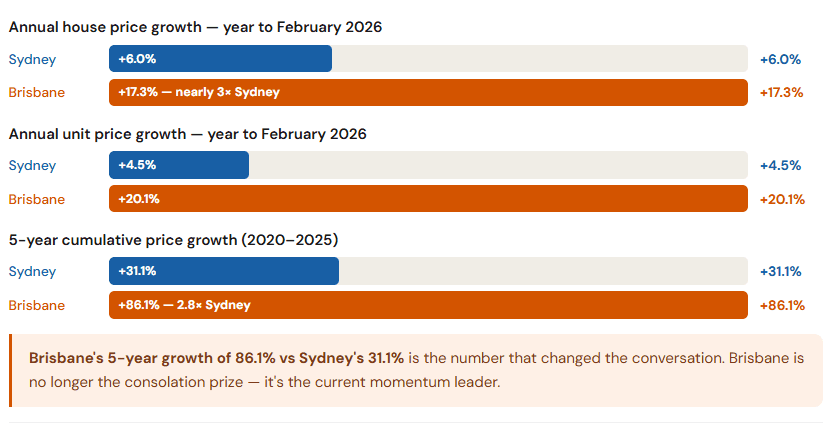
Sydney vs Brisbane — Property Market Snapshot, 2026
| Metric | Sydney | Brisbane | Source |
| Median house price | $1,296,039 | $1,080,538 | Cotality HVI Feb 2026 |
| Median unit price | ~$840,000 | ~$680,000 | Cotality HVI Feb 2026 |
| Annual house price growth | +6.0% | +17.3% | Cotality HVI Feb 2026 |
| Annual unit price growth | ~+4.5% | ~+20.1% | Cotality HVI Feb 2026 |
| Gross rental yields houses | 2.7% | 3.7% | PropTrack / SQM 2026 |
| Gross rental yields | ~3.5% | ~5.0% | PropTrack / SQM 2026 |
| Rental vacancy rate | 1.3% | 0.8% | SQM Research 2026 |
| Population growth | +100,000+ | +90,000+ | ABS 2025 |
| 5-year price growth | +31.1% | +86.1% | Cotality |
Source: Cotality HVI February 2026 · PropTrack · SQM Research Feb 2026 · ABS Overseas Migration 2025
The $215,000 difference — which sounds enormous, but here’s the thing. Once you look at what each city actually earns in rent relative to what you paid for it, that gap feels a lot smaller. Brisbane is generating more rental income per dollar invested. That’s really the heart of this whole comparison.
Sydney: The Market That Refuses to Stay Down
Let’s start with Sydney, because it deserves an honest conversation — not just the lazy “it’s expensive but prestigious” summary it usually gets. Here’s what makes Sydney genuinely different from almost every other property market in the world. It hasn’t been able to for 30 years. And nothing on the horizon suggests that’s changing.
What’s actually keeping Sydney moving in 2026?
The land shortage in Sydney isn’t going anywhere. With the harbour, national parks, and long-established suburbs, there’s just no room left to build on a large scale. Because of that, the challenge isn’t finding tenants — it’s choosing the right one. Rents are already high (around $900 a week for houses) and still rising. And the demand behind that is huge. In simple terms it defines strong demand, limited supply — and that’s what keeps the rental market so tight.
Where does Sydney get harder to love?
The yield numbers are genuinely painful. At $1.296 million median and $906 a week in rent, your gross yield on a Sydney house is about 2.7%. After you subtract management fees, land tax, council rates, insurance, and the inevitable maintenance costs — you’re probably netting somewhere between 1.5% and 2%. When the cash rate is above 4%, that’s a very thin margin to be operating on.
And the entry cost is serious. A 20% deposit on a $1.3 million home is $260,000 — before stamp duty, legal fees, or building inspections. That’s not a number that works for everyone, and it doesn’t mean those investors are doing anything wrong. It just means the maths doesn’t stack up at that price point for a lot of people.
Brisbane: This Stopped Being the Backup Plan a Long Time Ago
A few years back, Brisbane was what people recommended when they said “if you can’t make Sydney work, try Brisbane.” That thinking is well and truly behind us.
Brisbane in 2026 isn’t the consolation prize. For a lot of serious investors, it’s the first conversation — not the fallback. And the reason is straightforward. It’s producing better returns right now, the growth momentum is real, and you can still get in at prices that actually make sense.
What’s driving Brisbane in 2026?
Each of those projects lifts demand in surrounding suburbs and changes what those areas can command in rent and resale. Investors who got in before 2020 have had an extraordinary run. Those getting in now are still ahead of a lot of the delivery. The population shift is real and ongoing. The move from Sydney and Melbourne to Queensland didn’t end when COVID did. Lifestyle, affordability, warmer weather, the flexibility of remote work — these aren’t temporary reasons. That demand is still being absorbed.
The yields are genuinely hard to argue with. At 0.8% vacancy — the tightest of any major capital city in the country — gross house yields sitting at 3.7% and unit yields approaching 5%, Brisbane is generating cashflow that Sydney simply cannot match at current price levels.
Where Brisbane asks more of you?
Fast-moving markets can go the other way too. A 17.3% annual growth rate is impressive. But it also means there’s more distance to fall if sentiment turns or supply arrives faster than expected. Sydney’s steadier growth is partly a function of how deep and mature that market is — it takes a lot to move it significantly in either direction, which cuts both ways.
Where the Numbers Actually Land: Property ROI in 2026?
Sydney vs Brisbane — Property ROI in 2026
| Property ROI in 2026 | Sydney | Brisbane | Winner |
| Median house price | $1,296,039 | $1,080,538 | Brisbane— $215K cheaper |
| Median unit price | ~$840,000 | ~$680,000 | Brisbane— $160K cheaper |
| Annual house growth | +6.0% | +17.3% | Brisbane— nearly 3× Sydney |
| 5-year house growth | +31.1% | +86.1% | Brisbane— 2.8× Sydney |
| Gross yield — houses | 2.7% | 3.7% | Brisbane— 1.0pp higher |
| Gross yield — units | ~3.5% | ~5.0% | Brisbane— 1.5pp higher |
| Vacancy rate | 1.3% | 0.8% | Brisbane— tighter market |
| Weekly rent — houses | $906/wk | $730/wk | Sydney— high dollar amount |
| Market depth and liquidity | Very deep | Growing fast | Sydney — more liquid at exit |
| Long-term capital growth (30-yr track) | Exceptional | shorter record | Sydney — more history |
| Short to medium-term ROI (1–5 years) | Moderate | High | Brisbane — clear winner |
| Volatility risk | Lower | Higher | Sydney — more stable |
Source: Cotality HVI Feb 2026 · PropTrack · SQM Research Feb 2026 · ABS · Queensland Revenue Office · Revenue NSW · NextHouse analysis
The Yield Gap — What It Means in Your Pocket
This is the part that matters most if you’re trying to cover a mortgage right now.
Gross Rental Yields Comparison — Houses and Units
| Property Type | Sydney Yield | Brisbane Yield | Annual Difference per $1M invested |
| Houses | 2.7% | 3.7% | Brisbane generates ~$10,000 more per year |
| Units | ~3.5% | ~5.0% | Brisbane generates ~$15,000 more per year |
On every $1 million you put in, Brisbane puts an extra $10,000 to $15,000 per year in gross rental income back into your account — depending on the property type. When you’re trying to service a mortgage at 4%-plus interest rates, that’s not a rounding error. That’s a real difference.
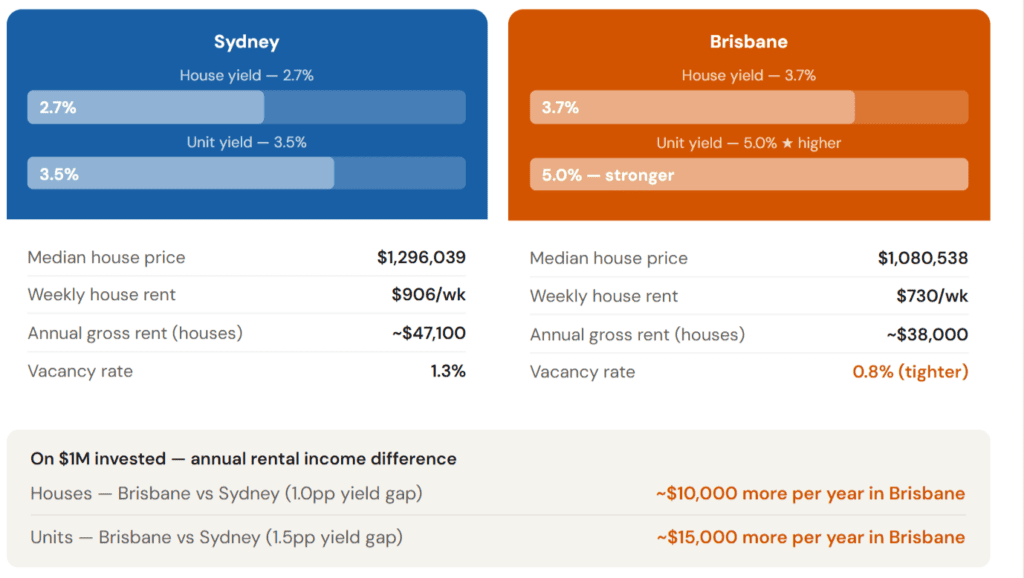
The flip side is worth noting though. Sydney rents are higher in straight dollar terms — $906 a week versus $730 for houses. The yield gap exists because Sydney’s purchase prices have grown faster than the rents have kept up with. If Sydney rents keep rising — and at 1.3% vacancy, there’s no reason to think they won’t — that gap will gradually close.
Who Should Actually Choose Which City?
Most property articles dodge this question. Here’s a direct answer. Sydney vs Brisbane
Which City Suits Which Investor?
| Investor Profile | Better City | Why |
| First-time investor with $200K–$400K deposit | Brisbane | Lower entry price, better yield, stamp duty concessions on new builds |
| Experienced investor adding to an existing portfolio | Brisbane | Stronger short to medium-term ROI — better cashflow in a high-rate |
| Investor with $500K+ deposit and a 10+ year horizon | Sydney | Deep liquidity, long-term track record, prestige premium that holds |
| Investor focused on rental yields and cashflow | Brisbane — clearly | 3.7% vs 2.7% on houses, 5.0% vs 3.5% on units |
| Investor prioritising stability over maximum return | Sydney | Less volatile, more established, larger buyer pool when you sell |
| Investor targeting Olympic infrastructure uplift | Brisbane | 2032 pipeline still delivering — still ahead of the curve |
| SMSF investor needing cashflow positivity | Brisbane | Higher yields make positive cashflow genuinely achievable |
5 Things Both Cities Have in Common — And Why They Matter
Before you get stuck choosing between Sydney and Brisbane, it helps to zoom out a bit. Because the truth is, they’re both dealing with the same big forces.
- First, neither city is building enough homes. There just isn’t enough supply to keep up, and that’s not changing anytime soon. That shortage is a big reason both markets keep moving forward.
- Second, people just keep coming. Sydney is growing fast, and Brisbane isn’t far behind. These aren’t places where demand is slowing — if anything, they’re struggling to keep up with how many people want to live there.
- Third, both cities are going through major upgrades. New transport, big infrastructure, and city improvements are happening in both places. They’re evolving, not sitting still.
- And finally, the rental market? It’s firmly on the landlord’s side in both cities. There aren’t many properties sitting empty, which means good tenants are there — and they don’t take long to find.
The RBA cash rate at 4.10% doesn’t care whether your property ROI in 2026 with Sydney or Brisbane. The pressure on borrowers — and the opportunity for investors — is identical either way.
What Do You Think: Sydney vs Brisbane?
If the question is purely about ROI right now, in 2026 — Brisbane wins. Lower entry prices, stronger yields, faster growth, tighter vacancy, and the Olympics infrastructure tailwind still running. On a pure return basis, Brisbane is the stronger performer right now. If the question is about the safest, most proven long-term wealth platform — Sydney wins. Thirty years of sustained growth, a massive and liquid market, a prestige premium that doesn’t erode, and a supply shortage that nobody has figured out how to solve. Sydney is Australia’s blue-chip property asset, full stop.
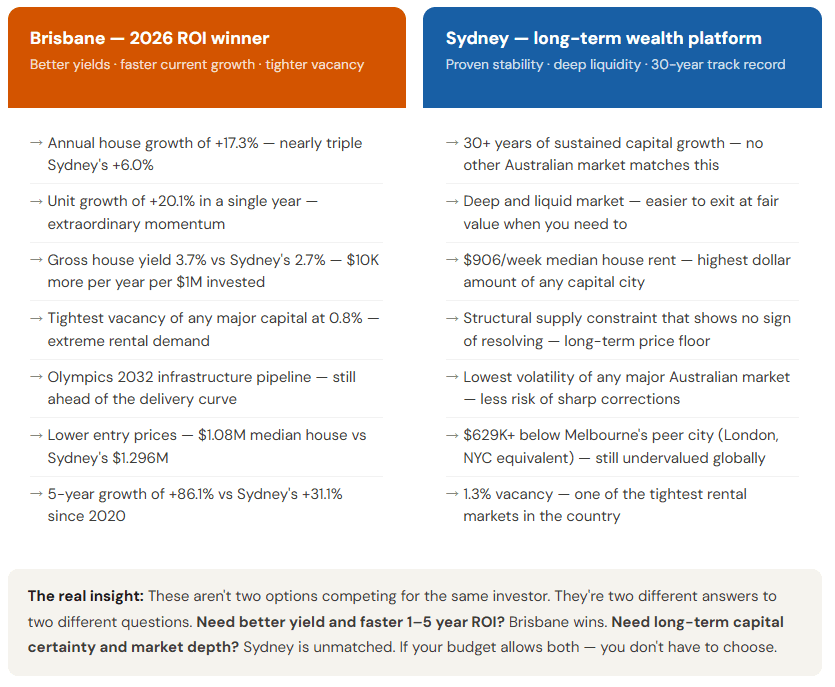
But here’s what’s easy to miss. These aren’t actually opposing answers. They’re answers to two completely different questions. A Brisbane purchase and a Sydney purchase in 2026 are doing different jobs for your wealth. Get NextHouse clear on those three things and the city choice tends to answer itself.
Disclaimer: This report is for educational and informational purposes only. It does not constitute financial, investment, or legal advice. Always seek professional advice before making property decisions.