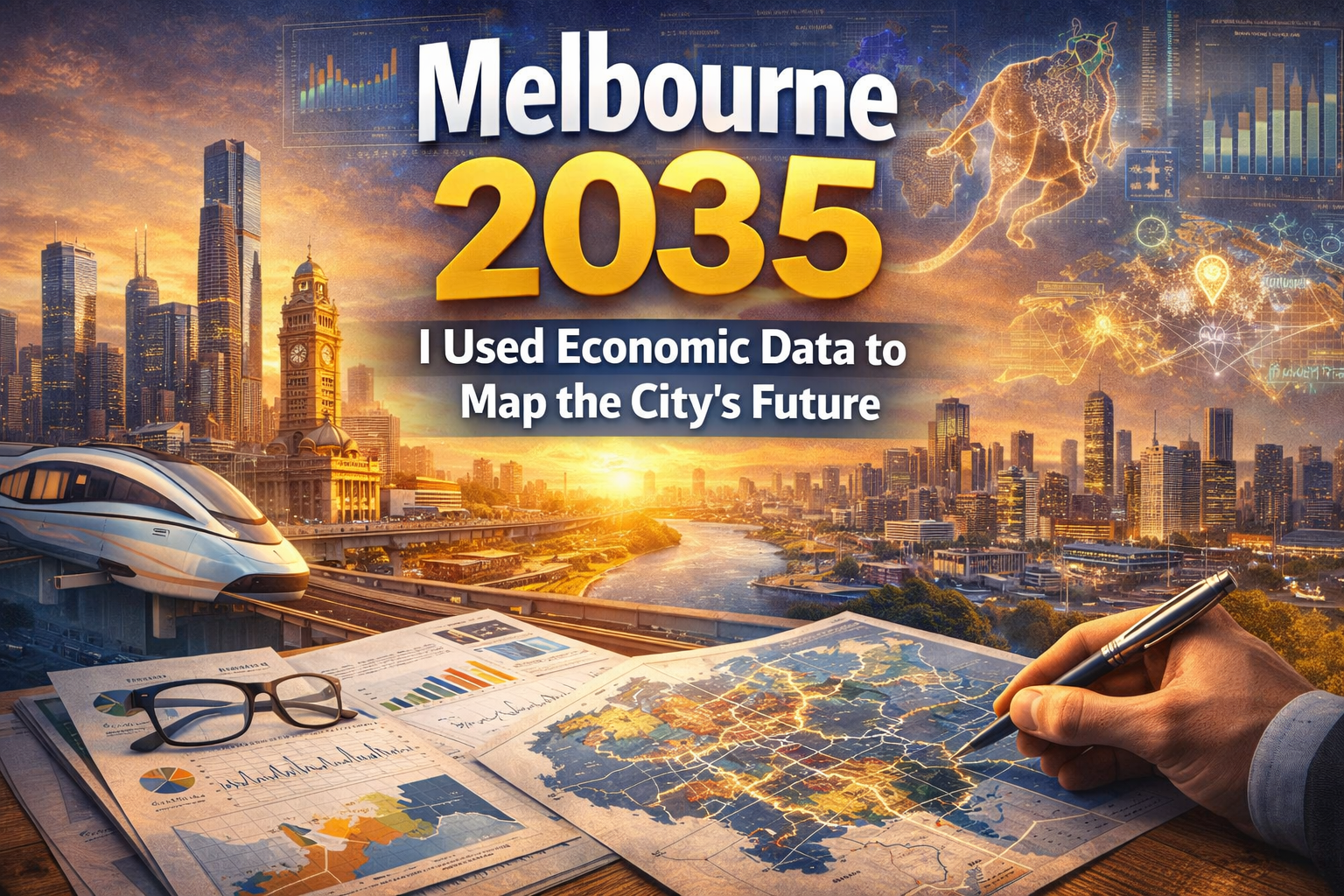
Most property articles about Melbourne 2035 are written with a conclusion already in mind. Someone wants to sell you something, or convince you of something, and the piece is built backwards from there. This one works differently.
Everything here comes from the actual numbers — ABS population data, the Victorian Government’s own housing supply figures, Cotality price series, and the infrastructure timelines that have already been committed and funded. No agenda. No narrative dressed up as analysis.
What those numbers show is a city at a genuinely interesting turning point. And if you’re thinking about property in Melbourne right now, understanding what the data is pointing toward — before the broader market does — is probably worth your time.
Melbourne 2035 – Is Melbourne Growing Faster Than Any Other Australian City
Mostly overseas around 85% of Melbourne’s growth. Skilled migration programs keep choosing Melbourne over other cities. Healthcare and tech companies are actively going out and recruiting global talent and bringing them here. This isn’t a sudden rush of people that’s going to ease off in a year or two. It’s been building for decades — driven by education, jobs, and the simple fact that Melbourne is genuinely one of the most liveable cities in the world.
That might not sound dramatic but think about what older residents actually want from a home. Something smaller and easier to manage. A train station they can walk to. That shift in what people genuinely need from their homes is already changing which suburbs are in demand — quietly, without much fanfare. It doesn’t always show up in the big headline numbers. But it absolutely shows up in which suburbs hold their value over time and which ones don’t.
Melbourne 2035 – The City Isn’t Building Enough Homes
Here’s where things get really interesting.
Melbourne is simultaneously the fastest-growing major city in Australia and the one building the fewest new homes relative to that growth. The Victorian Government’s own Urban Development Program tells the story plainly. Every year, fewer homes — while more than 142,000 new people keep arriving.
At the same time, apartment approvals recently hit a near 20-year low. Construction costs are up 35–40% since the pandemic. Rental vacancy is already sitting at 1.5–1.8%. Rents grew 8–10% in 2023–24. When demand keeps rising and supply keeps falling, the direction of prices isn’t hard to work out.
Why Has Melbourne Been Underperforming?
Here’s something that doesn’t get talked about enough. Over the five years from 2020 to 2025, Melbourne’s property values grew by just 14.3%. Meanwhile Perth went up over 70%. Brisbane climbed around 60%. Adelaide rose 55%. Even Sydney — which most people assume is always the expensive one — gained 28%. Melbourne, Australia’s second-largest city, the fastest-growing, the most internationally connected — finished last. By a significant margin.
That underperformance has created something unusual. A city of 5.3 million people, with a structural housing shortage and more infrastructure investment than anywhere else in the country and it’s cheaper than Brisbane. The major forecasters have noticed. KPMG is projecting Melbourne house prices to climb 6.6% in 2026 — the strongest forecast of any Australian capital. Westpac has upgraded to +10% for 2026. Domain is forecasting a house median of $1.11 million by the end of FY2026. ANZ and PropTrack both identify Melbourne as a top performer for catch-up growth through 2026–2028.
The underperformance created the gap. The fundamentals are now in place for that gap to close.
Melbourne 2035 – $100 Billion of Infrastructure Is Reshaping the City
No other Australian city has anything close to the infrastructure transformation currently underway in Melbourne. Victoria’s Big Build represents over $100 billion in committed spending — and a significant portion of it is already done. The Metro Tunnel opened in August 2025. Five new underground stations. Five-minute peak frequencies. The biggest change to Melbourne’s rail network in decades.
The West Gate Tunnel is open. Peak travel times between Melbourne’s western suburbs and the CBD dropped by around 20 minutes overnight. The commute economics of the entire western corridor changed permanently. Each removal upgrades a station precinct and creates the conditions for new development to follow. The Suburban Rail Loop is the one that will define Melbourne’s next decade.
The SRL East — connecting Box Hill to Cheltenham via Clayton and Monash — is the largest infrastructure project in the city’s history. $34.5 billion committed for the first stage. When it opens between 2035 and 2037, Melbourne will have a circumferential rail network for the first time — connecting major employment hubs without needing to pass through the city centre.
The Planning Change Most Investors Don’t Know About
The most significant planning shift in Melbourne’s history is happening quietly right now. The Victorian Government’s Activity Centres Program has designated over 60 train and tram station precincts across Melbourne as zones for fast-tracked high-density residential development. In April 2025, Amendment GC252 rezoned land across 12 planning schemes — making the uplift a legal reality, not a promise.
Within 400–800 metres of a designated station, eligible developments are now deemed to comply with planning rules automatically and are exempt from the normal review process. That cuts approval time dramatically, makes development feasible in locations where it wasn’t before, and creates a planning-driven uplift in site values that can add 30–80% to what land is worth.
Melbourne 2035 – The Melbourne Suburbs Worth Watching
Sunshine — $809,000 median. Growing at 8.8% annually across the Brimbank LGA. Unit rental yield of 4.78%. Just 12km from the CBD. About to become Melbourne’s airport transport hub when the Airport Rail opens. One of Melbourne’s seven National Employment and Innovation Clusters — yet sitting 17% below Melbourne’s median price. That gap is the opportunity.
Footscray — $923,000 median. Just 5km from the CBD. The gentrification wave is moving west. Unit yields sitting at 5.85% — among the highest in inner Melbourne.
Box Hill — The confirmed SRL East station. A $1 billion mixed-use precinct already underway from Vicinity Centres. Eastern Health expanding. Box Hill may already reflect much of the coming uplift — the more interesting play could be adjacent Activity Centre suburbs like Blackburn, Nunawading, and Ringwood, where prices haven’t moved as sharply yet.
Coburg — 8km from the CBD. Rental vacancy of just 0.8%. A $1 billion transformation of the Pentridge precinct bringing 1,500 apartments and retail. Pilot Activity Centre status. Two-year price growth of 8–10%. One caveat: 786 apartments are in the pipeline. Buy houses here — not the apartments that are creating the suburb’s uplift.
Reservoir and Preston — 9–11km from the CBD. Rental vacancy of 0.8%. Two-year price growth of 8–12%. Level crossing removals upgrading the Upfield line. Gentrification spreading north from Northcote and Brunswick. These are the suburbs where the buyer who can’t quite afford Fitzroy ends up — and that pattern of demand is structural, not cyclical.
Tarneit and Werribee — Around $620,000 median. Wyndham LGA growing at 4.2% per year — one of Australia’s fastest. The West Gate Tunnel already cutting 20 minutes off the CBD commute. The simplest case in Melbourne: buy where the people are coming.
What to Buy and What to Avoid?
Worth buying: Land within 800–1,200 metres of a designated Activity Centre station where the rezoning has already occurred but prices haven’t fully adjusted. The legal uplift is there — the price just hasn’t reflected it everywhere yet.
Worth buying: Houses in suburbs where a lot of new apartments are being built. In places like Footscray, Coburg, and Box Hill, the house market tends to do better — because while hundreds of new apartments are coming onto the market, actual houses stay scarce. The apartments lift the whole suburb’s profile and demand, and your house rides that wave. You get the growth without the risk that comes with buying off the plan and waiting two years for your apartment to settle into an oversupplied market.
Worth avoiding: Off-the-plan apartments in pipeline-heavy precincts. Coburg has 786 apartments coming. Box Hill has 1,900-plus from Vicinity Centres alone. Investors in existing apartments may face direct competition from cheaper new stock during settlement waves — which puts real pressure on both capital growth and yields.
One Thing to Factor In Before You Commit
Victoria’s land tax threshold for investors was cut from $300,000 to $50,000 from January 2024. Many investors who previously paid nothing are now receiving annual bills of hundreds to thousands of dollars. A Vacant Residential Land Tax now applies statewide from January 2025.
Run the full numbers before you commit. Focus on yield as well as growth — make sure the holding cost is genuinely manageable at current rates and at rates somewhat higher. The fundamentals in the right Melbourne locations are strong enough to absorb these costs. But only if the numbers actually work for your situation.
Conclusion
A network that loops around the city for the first time rather than just running into it. An airport link that puts Sunshine at the centre of Melbourne’s western transport map. More than 60 station precincts legally rezoned for higher density. They’re the ones where a planning change, a major employer, and genuine population pressure are all pointing in the same direction at the same time. Sunshine, Footscray, the SRL corridor suburbs, and the inner-north belt from Preston down through Coburg all fit that description today — before the market has fully worked it out.
The investors who do well in Melbourne over the next decade won’t be the lucky ones. They’ll be the ones who read what was already there — and moved while it still mattered. At NextHouse, every recommendation we make is grounded in data you can verify. If you’re serious about Melbourne property and want to understand about your next move, our team is here to help.
FAQs
- Is Melbourne property actually a good investment right now?
Honestly — yes. And the numbers back it up. That gap between growth and price performance doesn’t last forever. The housing shortage is real, the infrastructure spending is the biggest of any city in the country, and the major forecasters are all pointing to Melbourne as the one to watch through 2026–2028. - Which Melbourne suburbs are actually worth paying attention to right now? A major employer or hospital or university anchoring local demand. And strong, consistent population growth feeding into the area. When all three line up in the same suburb at the same time, that’s historically where property values move — not because of hype, but because the underlying demand is genuinely there.
- What is the Activity Centres Program and why should investors care?
What that does in practice is push up the value of land near those stations — because developers can now build there with far less time and uncertainty. The rezoning has already been done legally in many of these areas. The prices just haven’t fully moved yet. - What does the Suburban Rail Loop mean for property investors?
Developers are already buying land along the SRL corridor — which tells you something about where they think prices are heading. History shows that property within 800 metres of a new train station typically rises 2–10% just from the infrastructure alone. The investors who buy into these suburbs before the line opens are the ones most likely to capture that growth. - Should I buy a house or an apartment in Melbourne?
House supply stays limited while all the new apartments actually help lift the suburb’s profile and demand. The risk with off-the-plan apartments in these areas is that when hundreds of new units hit the market at once, they compete directly with each other and push prices and rents down. - How does Victoria’s land tax change affect me as an investor?
From January 2024, the threshold at which you start paying land tax dropped significantly — from $300,000 worth of investment property down to $50,000. A lot of investors who never paid land tax before are now getting bills every year. It’s not a reason to avoid Melbourne — the fundamentals in the right suburbs are strong enough to handle it. But it does need to go into your numbers before you buy, not after you’ve already committed.
Disclaimer: This report is for educational and informational purposes only. It does not constitute financial, investment, or legal advice. Always seek professional advice before making property decisions.